
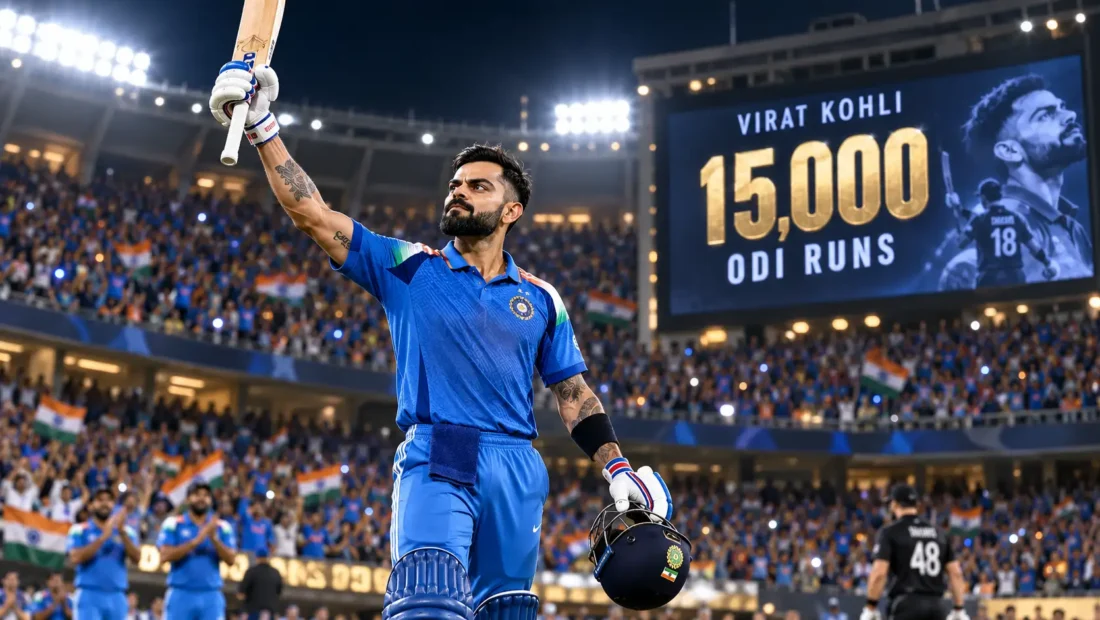
Virat Kohli crossed 15,000 ODI runs on Sunday and did it during an innings that reflected the change he says he is trying to make late in his career. The India batter finished unbeaten on 139 from 88 balls against West Indies, registering his 55th century in the format and, according to the source, the third-fastest ODI hundred of his career. The milestone itself was significant, but Kohli’s comments afterwards focused less on the number and more on the challenge of finding a higher gear at 37.
A major milestone arrives with one of Kohli’s most aggressive ODI hundreds
Kohli described the task as trying to unlock a new version of himself. After two decades at the top level, he said the challenge of increasing his scoring tempo has given him something fresh to work on. The result in Thiruvananthapuram was an innings built around controlled aggression rather than simply surviving a chase. India were pursuing 296, and Kohli’s approach showed that he is trying to combine the long-innings instincts that defined much of his ODI career with a willingness to attack earlier and more often.
Nine sixes underline the change in scoring tempo
The most visible sign of that shift was the number of sixes. Kohli hit one within his first five balls, even though the first came from a top edge, and he continued to clear the boundary throughout the innings. He finished with nine sixes, a new personal best in ODI cricket, alongside ten fours. Three of those fours came in succession during the 29th over, the passage in which he moved beyond 15,000 ODI runs. For a batter long associated with running, placement and calculated accumulation, the boundary count gave the innings a different shape.
That does not mean Kohli has abandoned his traditional method. His own explanation is about adding another layer rather than replacing everything that came before. He still wants to understand the match situation and remain at the crease long enough to influence the result. The change comes after he feels set. At that point, he is now trying to take the maximum available return from each ball instead of always choosing the lowest-risk option. The nine sixes are therefore best read as evidence of a deliberate adjustment rather than a one-off attempt to play recklessly.
| Measure from the innings | Figure | Context in the source |
|---|---|---|
| Score | 139 not out from 88 balls | 55th ODI century |
| Boundary sixes | 9 | New personal best |
| Fours | 10 | Included three in a row in the 29th over |
| Career milestone | 15,000 ODI runs | Second player to reach the mark after Tendulkar |
| 2026 ODI runs at the time of report | 523 | Third-highest total for the year |
| 2026 strike rate cited | 116.74 | Only three of the top 50 scorers could match or exceed it |
Kohli says milestones are a consequence rather than the target
Despite the attention around 15,000 runs and a 55th century, Kohli said milestones are not what he uses to organise an innings. His emphasis remains on reading the situation and doing the job required for the team. That perspective is consistent with the way he framed the landmark afterwards: he expressed gratitude for the longevity that made it possible but did not describe the number as the main purpose of the chase. The milestone arrived because he had spent years scoring ODI runs, not because he entered the match solely trying to reach a round figure.
The source identifies Tendulkar as the only player to have reached 15,000 ODI runs before him. That comparison places Kohli’s longevity in obvious historical company, but his own language keeps returning to process. He says the answer is to keep working, stay grateful and continue playing the role the team needs. It is a useful contrast with the public narrative around records. Supporters and broadcasters naturally count centuries and career runs; the player is trying to keep those numbers from becoming the reason he changes the way he approaches each ball.
Positive does not mean reckless in Kohli’s new template
Kohli’s key distinction is between positive batting and reckless batting. He said he has made a promise to himself to play positively because he believes he has the ability to do it. At the same time, experience should help him recognise the line between an attacking option that fits the situation and a shot that gives away his wicket unnecessarily. That balance is central to the new version he is describing. The aim is not simply to hit more sixes; it is to increase scoring pressure without losing the judgement that has supported his long ODI career.
That becomes especially important in a chase. Kohli has built much of his reputation around controlling targets, staying deep into innings and making the required rate feel manageable. A more aggressive template can strengthen that skill if it reduces pressure earlier, but it can weaken it if aggression turns into unnecessary risk. His unbeaten 139 offered an example of the version he wants: high tempo, a large boundary count and enough control to remain there at the end. The innings therefore connected his older strengths with the new emphasis rather than forcing a choice between them.
The 2026 numbers show the faster approach is already visible
The change is not limited to one innings. The source says Kohli had scored 523 ODI runs in 2026 at the time of the report, making him the third-highest run-scorer of the year. More strikingly, his strike rate was 116.74, and only three players among the top 50 run-scorers could match or better that rate. Those figures support his claim that he has been trying to score at a higher pace rather than merely discussing a future adjustment after one successful match.
Strike rate by itself does not tell the whole story, because role, match situation and opposition all matter. But alongside the unbeaten 139 and nine sixes, it provides a consistent signal. Kohli is trying to retain the volume of runs associated with his career while changing how quickly they arrive. At 37, that is a demanding combination. A player can become more aggressive by accepting shorter innings, or maintain an average by reducing risk. Kohli’s challenge is to push both aims together without losing the control that made his earlier ODI method so effective.
Fitness remains the foundation for the freedom he wants at the crease
Kohli links the mental freedom of his batting to physical conditioning. His explanation is almost reversed from the common idea that a relaxed mind leads to better movement: he says a fit body helps him create the free mind he wants. If he trusts his conditioning, he can visualise how he intends to play and then give himself a better chance of executing that plan. At this stage of his career, fitness is therefore not presented only as a way to extend longevity. It is part of the mechanism that supports a faster and more expressive batting style.
That connection is easy to see in ODI cricket, where a long innings can involve repeated sprints, rapid turning and the physical demands of batting under pressure for an extended period. Kohli’s new approach also asks him to generate more boundary power while preserving concentration. The source does not provide training details or changes to his fitness programme, so there is no basis for inventing a new regimen. What he does say clearly is that physical readiness gives him the confidence to play with the mental freedom he is seeking.
Mental freshness matters more to him than heavy practice volume
Kohli also said he has never been a player who needs enormous amounts of practice, even when he was playing all formats. His emphasis is on remaining mentally fresh, staying in the present and expressing the style he has visualised. That approach helps explain why he talks about a template rather than a technical overhaul. The goal is to become comfortable with a certain decision-making pattern in matches, not necessarily to rebuild his batting through endless net sessions.
At an experienced stage of a career, that distinction can matter. Technical skill is already deeply established, and the challenge can become choosing when to access different parts of it. Kohli’s description suggests he is working on permission as much as technique: permission to attack, to trust his conditioning and to take a higher scoring option when the situation allows. He still places limits around that freedom, which is why he repeatedly returns to the idea of not being reckless. The new version is meant to be more expansive, not less disciplined.
The 2027 World Cup remains part of the longer-term picture
Before this series, Kohli had spoken about wanting to hit the winning runs in the 2027 World Cup final. That ambition gives his current adjustment a clear competitive context. He is not changing his ODI method only to chase personal strike-rate numbers late in his career. He wants a version of his game that can still contribute at the highest level when the next global tournament arrives. The source does not guarantee his selection or predict what role he will have, but it shows that he is thinking about the World Cup as part of the reason to evolve.
The timing is significant because a player with Kohli’s experience could easily focus on preserving the method that has already produced extraordinary returns. Instead, he describes being excited by the need to improve. That attitude gives the 15,000-run milestone an unusual framing. It is not presented as a point where the career becomes a museum of past achievements. It sits beside a conversation about what he still wants to add. The record marks continuity, while the nine sixes and higher strike rate point toward change.
Gratitude is the other theme running through Kohli’s comments
Kohli’s post-match comments were not only about tactics and fitness. He also spoke at length about remembering where he came from and resisting the way fame and attention can make a player forget the beginning of the journey. Looking back to childhood, he said, helps him stay grateful for the fact that he gets to represent India in front of large crowds. That perspective is part of how he keeps motivation clear after a career that has already contained most of the milestones a batter could realistically chase.
The gratitude theme also fits his claim that records are secondary. If he treats the career as an opportunity he might never have had, each match becomes valuable independently of whether it produces another round number. He said he wants to keep working, enjoy the experience and give supporters reasons to smile. The supplied source does not present that as a retirement message. Quite the opposite: it sits alongside his desire to increase the tempo of his batting and contribute in future tournaments.