
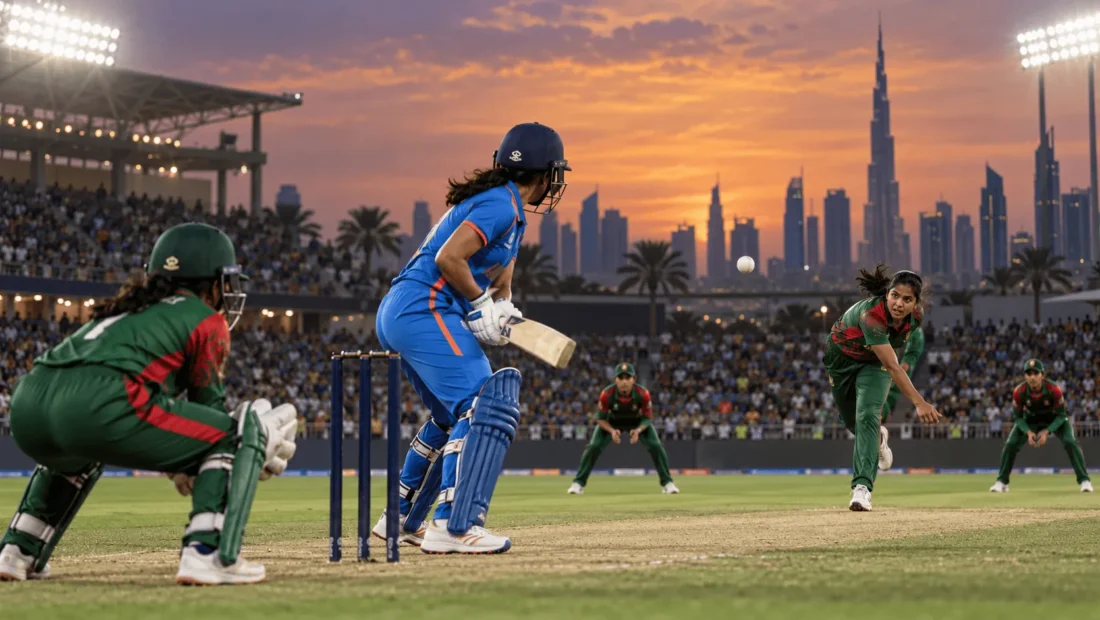
Bangladesh captain Nigar Sultana won her first toss of the Women’s T20 Asia Cup 2026 and chose to bowl first against India in the semi-final in Dubai. India captain Harmanpreet Kaur was comfortable with the outcome, saying she would have preferred to bat first anyway and back a total on the board in a knockout match.
The decision set up a straightforward contrast in approach. Bangladesh accepted the responsibility of chasing, while India took the opportunity to establish the target. Both sides kept the same XIs from their previous matches, suggesting that neither captain felt the need to make a late tactical change for the semi-final.
Nigar acknowledged Bangladesh’s famous 2018 success but made it clear that the older result could not carry much weight in a current knockout game. Her focus was on the immediate consequence: lose and the tournament is over. Harmanpreet offered a similar note of caution from the other side, stressing that no team can be treated lightly in T20 cricket.
The contest arrived with India holding a substantial recent advantage. They had not lost a T20I to Bangladesh since July 2023 and had won all eight meetings between the teams in that period. The overall head-to-head record stood at 21-3 in India’s favor. That history made India the form side in the matchup, but a semi-final reduces the value of past results to context rather than guarantee.
A Toss That Suits Both Captains
There was little disappointment on either side when Nigar called correctly. Bangladesh wanted to bowl, and India wanted to bat. In practical terms, the toss simply allowed both teams to begin the semi-final with the plan they preferred.
For Bangladesh, bowling first means the chase will come with a known target. That can be useful in a tournament that has generally produced lower scores, because the batting side can judge risk against the required rate instead of estimating what an adequate first-innings total might be. The trade-off is obvious: a strong India powerplay or a late acceleration could create scoreboard pressure before Bangladesh begin their reply.
India’s preference for batting first is equally easy to understand from Harmanpreet’s comments. A knockout total can force the chasing side to make decisions under pressure, particularly if early wickets push the required rate upward. India also entered the match with the confidence of a dominant recent record against this opponent, which makes setting the terms of the game attractive.
None of that guarantees the direction of the match. T20 cricket can shift in a few overs, and Harmanpreet explicitly warned against taking Bangladesh lightly. The toss merely establishes which team gets the first chance to impose its plan.
Pitch Report Points to Better Batting Conditions
The wider tournament had been low scoring, but the pre-match pitch report offered a slightly different expectation for the semi-final. Veda Krishnamurthy described the surface as a beautiful one for batting. That assessment increases the possibility that this game could move away from the cautious totals seen elsewhere in the competition.
A better batting surface would place extra importance on execution rather than survival. India would have the first opportunity to test how true the pitch plays, while Bangladesh’s bowlers would need to work out quickly whether pace changes, spin or tighter lines are required to slow the scoring.
For Bangladesh, the information gained in the first innings could later help the chase. They will see exactly how the surface behaves under match pressure before their batters walk out. India, on the other hand, can create the benchmark. If conditions really are as favorable as the pitch report suggests, a conservative total may not be enough.
Bangladesh Keep Faith With the Same XI
Bangladesh named an unchanged side led by Nigar, who also keeps wicket. The listed batting order begins with Dilara Akter and Juairiya Ferdous, followed by Sobhana Mostary and Nigar. Sharmin Akter and Shorna Akter provide the next layer before Fahima Khatun, Nahida Akter, Rabeya Khan, Sultana Khatun and Marufa Akter complete the XI.
Keeping the same team in a semi-final can be read as a vote of confidence in the balance that brought Bangladesh this far. It also avoids asking a new player to enter the tournament in its highest-pressure match. The challenge is that the group now faces an India side it has not beaten in more than three years of T20I meetings.
Bangladesh’s first job is with the ball. Early control would prevent India’s top order from turning a favorable batting pitch into a runaway start. Just as importantly, wickets through the middle overs would make it harder for India to preserve resources for a late surge. If Bangladesh can keep the target within reach, the decision at the toss will look increasingly valuable.
India Also Make No Changes
India’s XI also remains unchanged. Smriti Mandhana and Shafali Verma are listed at the top, followed by Pratika Rawal, Harmanpreet Kaur and wicketkeeper Richa Ghosh. Bharti Fulmali, Deepti Sharma, Prema Rawat, Kranti Gaud, N Shree Charani and Nandani Sharma make up the rest of the side.
The continuity reflects a team that has little reason to disrupt a winning combination. India enter the semi-final with the stronger recent head-to-head record and the confidence of eight consecutive T20I wins over Bangladesh since July 2023.
That history is useful, but the nature of the match still matters more. There is no second chance after a semi-final defeat. India’s top order therefore has to balance the freedom of a good batting pitch with the responsibility of building a total that leaves Bangladesh under pressure from the first over of the chase.
| # | Bangladesh | India |
| 1 | Dilara Akter | Smriti Mandhana |
| 2 | Juairiya Ferdous | Shafali Verma |
| 3 | Sobhana Mostary | Pratika Rawal |
| 4 | Nigar Sultana (capt & wk) | Harmanpreet Kaur (capt) |
| 5 | Sharmin Akter | Richa Ghosh (wk) |
| 6 | Shorna Akter | Bharti Fulmali |
| 7 | Fahima Khatun | Deepti Sharma |
| 8 | Nahida Akter | Prema Rawat |
| 9 | Rabeya Khan | Kranti Gaud |
| 10 | Sultana Khatun | N Shree Charani |
| 11 | Marufa Akter | Nandani Sharma |
Recent History Heavily Favors India
The 21-3 overall record is the clearest statistical gap between the sides. More relevant to the current squads is the recent sequence: eight meetings since July 2023, all won by India. Bangladesh therefore enter the semi-final trying to break not one isolated losing result but an extended run.
Nigar’s reference to 2018 was telling in that context. Bangladesh can draw confidence from knowing they have beaten India in a major regional tournament before, but she also described that success as a long time ago. The captain’s message was essentially to separate memory from the job in front of the current team.
India’s advantage is psychological as much as numerical. Repeated wins can create confidence in familiar matchups and situations. Yet those same expectations can create pressure for the favorite in a knockout game, especially if Bangladesh start well with the ball and make the contest feel different from the recent meetings.
The Semi-Final Equation
The match begins with both sides getting what they wanted from the toss. Bangladesh can attack with the ball and then chase a known number. India can set the target and try to let scoreboard pressure work for them. Both have unchanged XIs, so the contest is less about surprise selections than about which established plan survives the pressure of a semi-final.
The surface may also be decisive. If it plays as well as the pitch report suggests, the first innings could set a higher benchmark than the rest of the tournament. If the low-scoring pattern continues instead, every boundary and every quiet over will become more valuable.
For Bangladesh, a win would end India’s long recent streak in the matchup and put them into the final. For India, victory would extend a period of clear T20I dominance over Bangladesh and keep their Asia Cup campaign on course. The toss has been decided, the teams are unchanged, and the rest now comes down to execution.
Further Context
Knockout cricket often rewards the side that adapts fastest rather than the one that arrives with the better historical record. Bangladesh’s challenge is therefore to make the first few overs look unlike the previous eight meetings. Early wickets or a restrained India powerplay would immediately make the chase feel more manageable.
India’s task is the mirror image. A solid start would reinforce the recent head-to-head pattern and make Bangladesh chase the game both literally and tactically. The first innings should therefore provide a quick indication of whether the semi-final is following recent history or breaking away from it.
Because both teams are unchanged, there is also less uncertainty around roles. Each captain knows the resources available and can plan matchups from the opening over. The decisive difference is likely to come from execution under pressure rather than a surprise selection.
The contrast between the captains’ comments is subtle but useful. Nigar framed the game around survival in the tournament, while Harmanpreet emphasized the confidence that can come from posting a total. Both statements point to pressure, but from opposite directions: Bangladesh are thinking about the chase they chose, while India are thinking about the scoreboard they want to create.
The opening six overs should be particularly revealing. If India score freely, Bangladesh may be forced to attack for wickets earlier than planned. If Bangladesh keep the powerplay quiet, the recent head-to-head record will matter less because the match will enter the middle overs on more even terms.
The chase will then introduce a different kind of pressure. Bangladesh will know the exact equation, but that clarity can become uncomfortable if the required rate climbs. India, meanwhile, will be able to defend a number rather than an abstract par score. That is why both captains could genuinely be satisfied with the toss outcome despite wanting opposite things.