
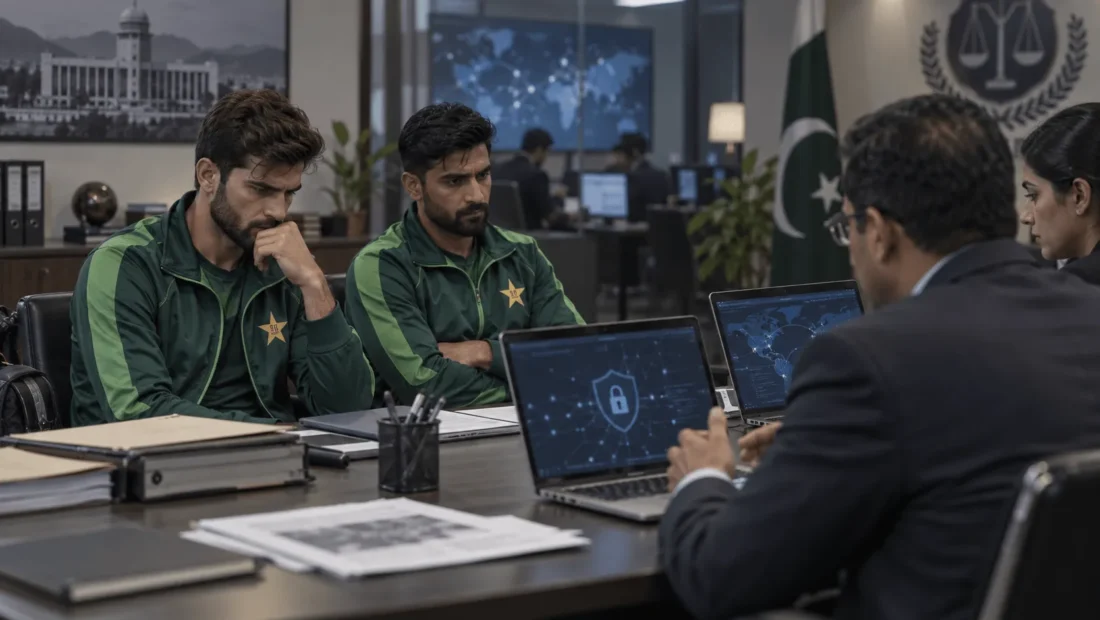
Mohammad Rizwan and Imam-ul-Haq have appeared before Pakistan’s National Cyber Crimes Investigation Agency in Lahore, adding another layer to the fallout from the national team’s difficult Test tour of England. Both players received summons and attended questioning on Thursday after being among the seven cricketers sent home following Pakistan’s defeat in the second Test at Lord’s.
The most important point at this stage is what is not known. Authorities have not publicly explained the subject of the questioning, and it is unclear whether the NCCIA process is connected to the Pakistan Cricket Board’s own disciplinary inquiry. Being summoned for questions does not, by itself, establish wrongdoing, and the available information does not identify any criminal allegation against either player.
What Is Known About the NCCIA Appearance
Rizwan and Imam were part of a group of seven players removed from the touring squad after the Lord’s Test. They were later summoned by the NCCIA and appeared in Lahore on Thursday. At least one of them is understood to have spent several hours with investigators, while at least one player has also been given a questionnaire that must be completed and returned next week.
Beyond those procedural details, the reason for the questioning remains undisclosed. That uncertainty matters because several different reviews are taking place around Pakistan cricket at the same time. The PCB announced an internal disciplinary process earlier in the week after media reports concerning discipline and conduct. The board did not identify the players involved in that inquiry and said the matter was being handled under its own regulations.
Without an official link between the two processes, it would be misleading to treat the NCCIA questioning as an extension of the PCB inquiry. The timelines overlap, but overlap is not proof of connection. For now, the responsible reading is simply that Rizwan and Imam have answered a summons from a federal cybercrime agency while a separate cricket-board review is also underway.
The Lord’s Defeat Triggered Major Changes
The questioning comes against the backdrop of a tour that had already moved into crisis territory. Pakistan lost the first Test by an innings and 103 runs and then went down by 194 runs at Lord’s. After the second defeat, seven players were removed from the squad along with head coach Sarfaraz Ahmed and bowling coach Umar Gul.
Seven replacement players travelled to England, five of them uncapped at international level. Such a large mid-tour change is unusual and signaled that the PCB viewed the problems as broader than a normal form slump. Chairman Mohsin Naqvi later said officials had discussed the reasons for the team’s performance and that some factors went beyond results on the field, although he did not provide details.
That comment has helped fuel speculation, but the board has not publicly set out a complete list of concerns. The internal inquiry statement refers generally to reports about discipline and conduct. Until findings are published, the distinction between confirmed facts and rumor is especially important.
Rizwan’s Difficult Run With the Bat
Rizwan’s place in the discussion is complicated by a clear contrast between his batting and wicketkeeping. His Test scores on the England tour were 12, 41, 7 and 1, continuing a period of relatively low returns after two Tests in the Caribbean. The dismissal for 1 in the second innings at Lord’s, when he attempted an ungainly attacking shot, drew particular criticism because it came during a match Pakistan were already struggling to save.
His work behind the stumps, however, was described as exemplary across both tours. Before the West Indies series, Rizwan had been Pakistan’s leading Test run-scorer from January 2024 onward. That longer record is relevant because it shows why the situation cannot be reduced to a simple claim that he had stopped contributing. The batting decline was real, but so was the recent history of productivity and high-quality wicketkeeping.
Selection decisions often become more complicated when a senior player is contributing strongly in one discipline and poorly in another. In Rizwan’s case, the immediate public criticism centered on the bat, while his keeping did not appear to be the problem. The later NCCIA summons is therefore a separate issue and should not be interpreted as a sporting judgment.
Imam’s Injury Became a Separate Point of Controversy
Imam-ul-Haq’s situation was different. He was diagnosed with a grade-one tear in his left calf after the first day at Lord’s and did not take the field during either Pakistan innings. On the final morning, he attempted gentle knockdowns during the warm-up but was visibly limited.
Aaqib Javed, the PCB’s chief selector and director of high performance, publicly questioned the injury and warned that it would be examined. That public skepticism turned Imam’s absence into more than a routine medical story. It also added to the sense that the board was reviewing decisions and conduct around the tour in a much broader way.
Again, the available information does not establish that the NCCIA questioning was about Imam’s injury or the PCB’s concerns. The events are part of the same period of turbulence, but the agency has not disclosed the subject of its interview.
Selectors Were Also Asked to Explain Their Decisions
The scrutiny did not stop with the players. After the Lord’s Test, the PCB sent a notice to selectors asking for written explanations of why Rizwan and Imam had been chosen for the West Indies and England tours and how those selections were reached. The notice requested a response within 24 hours.
Misbah-ul-Haq subsequently resigned from his role as a selector following the squad changes. That development shows that the board’s review extends beyond individual performances. Selection policy, medical questions, team conduct and coaching decisions have all become part of the wider discussion around the tour.
When several administrative processes unfold at once, it becomes easy to merge them into one narrative. But the current facts support a more careful picture: the PCB has a disciplinary inquiry, selectors were asked to explain decisions, Imam’s injury was questioned publicly, coaching and playing personnel were changed, and the NCCIA separately summoned Rizwan and Imam.
Why the Lack of Detail Matters
Cybercrime agencies can investigate a wide range of digital matters, so the name of the NCCIA should not be treated as evidence of a specific offense. Without an official statement identifying the subject, any attempt to guess whether the issue involves communications, online activity, leaked material or something else would go beyond the available information.
The same caution applies to the questionnaire. Being asked to provide written answers next week indicates that the agency is continuing to gather information, but it does not reveal what investigators are testing or whether the players are witnesses, subjects of inquiry or simply people with relevant information.
For both players, the most immediate reputational challenge is therefore uncertainty. Their names are attached to a federal-agency summons at a moment when Pakistan cricket is already under intense criticism. The absence of detail creates a vacuum that can easily be filled by speculation. Official findings, if and when they are released, will be far more meaningful than assumptions drawn from the fact of questioning alone.
Pakistan Cricket Is Managing Several Problems at Once
The broader context is a team trying to respond to heavy Test defeats while also dealing with internal questions about selection, fitness, discipline and leadership. Replacing seven players and two coaches during a tour is a major intervention. Asking selectors to justify decisions and opening an internal conduct inquiry adds another administrative layer.
Rizwan and Imam are senior enough that any process involving them will attract attention. Rizwan has been one of Pakistan’s most prominent multi-format players, while Imam has been a regular part of the Test batting conversation. That profile makes it even more important to separate performance criticism from the unresolved NCCIA matter.
For now, the confirmed sequence is limited but significant. Both men were dropped and returned home after Lord’s, both received NCCIA summons, both appeared on Thursday, at least one spent several hours with investigators, and at least one has a questionnaire to return next week. The subject has not been made public.
Until the NCCIA or PCB provides more information, that is where the story stands. The England tour has already produced substantial sporting and administrative consequences, but the cybercrime questioning remains an open process rather than a conclusion.
The Next Official Update Will Be More Important Than Speculation
The questionnaire due next week is the clearest sign that the NCCIA process has not ended with Thursday’s appearance. It may lead to further questions, requests for information or no public action at all. Until the agency states what it is examining, there is no reliable basis for predicting which of those paths is most likely.
The PCB faces a similar communications challenge. Its own inquiry has been acknowledged publicly, but the board has not named the players involved or published allegations. That leaves several high-profile developments occurring side by side without a confirmed connection. Any later announcement will need to distinguish clearly between cricket-board discipline, selection review and the separate work of the cybercrime investigators.