
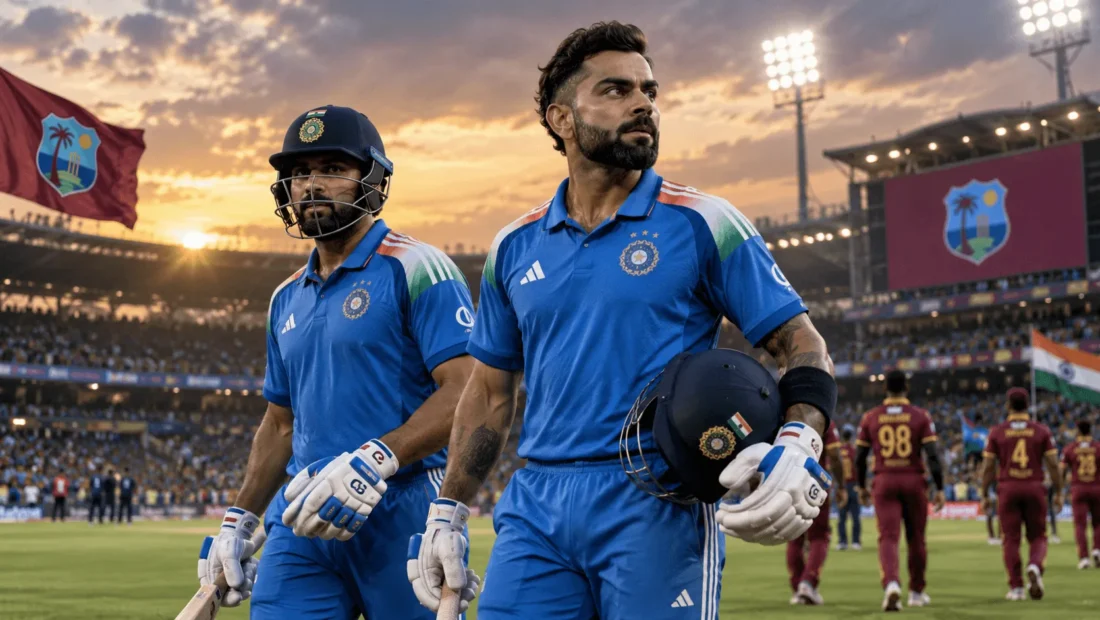
India’s selection meeting for the three-match ODI series against West Indies carries more significance than an ordinary bilateral squad announcement. Rohit Sharma’s place in the 50-over plans, Hardik Pandya’s fitness, the back-up wicketkeeping role and the composition of the spin and all-rounder group are all live questions as the Ajit Agarkar-led panel prepares to meet ahead of the series beginning September 27.
The meeting is also set to be the final one of Agarkar’s current tenure, which is due to end in early October. That timing gives the selection an unusual sense of transition. The immediate task is to choose a squad for West Indies, but almost every major decision is being viewed through the longer lens of the 2027 ODI World Cup in southern Africa.
The Rohit Sharma question returns
Rohit Sharma remains the biggest talking point. He has publicly made clear that he wants to play in the 2027 World Cup, yet the signals around his place in India’s ODI future have not always been consistent. During the England tour in July, it was learned that selectors had indicated they intended to move on from him. The BCCI later pushed back on that suggestion, with secretary Devajit Saikia saying Rohit remained part of the ODI plans.
The numbers have added to the discussion rather than settled it. Rohit made 26 from 47 balls in the second ODI in Cardiff, a performance that intensified debate over his role. Before the England tour he had scored 16, 48 and 79 against Afghanistan at home. Those returns were mixed, although he then struck a century in his most recent ODI innings at Lord’s.
The wider context is captaincy. India replaced Rohit with Shubman Gill as ODI captain in October 2025, not long after Rohit had led the side to the Champions Trophy title in March. Once a senior player is no longer captain, every selection becomes more directly about the role he is expected to fill as a batter. That makes the West Indies squad important because it may show whether the selectors still see Rohit as part of the preferred XI, a short-term option or a player who needs to keep demonstrating form as the World Cup approaches.
There is no definitive answer in the source material before the meeting. That uncertainty is itself the story. Wednesday’s discussion offers the panel a chance to clarify a position that has so far produced competing messages from selection chatter and the board’s public response.
Hardik Pandya’s fitness changes the balance
Hardik Pandya presents a different problem. His value to India comes from combining middle-order batting with seam bowling, but he has not played competitive cricket since IPL 2026 because of a run of injuries. He missed four games for Mumbai Indians with back spasms, was selected for the Afghanistan ODIs in June and then suffered a leg injury before that series.
At the time covered by the source, Hardik was doing conditioning work at the BCCI’s Centre of Excellence and was due to undergo a fitness test the following week. He was expected to be cleared, but clearance does not automatically mean immediate selection. The panel may prefer a more cautious return because of how important his dual role is to the structure of the ODI side.
The India A matches against Australia A in Puducherry, beginning October 6, are presented as a possible comeback route. That would allow Hardik to return through competitive cricket without making the West Indies ODIs the first test of his readiness. The selectors are also understood to want him concentrating on 50-over cricket for now rather than T20Is, with the 2027 World Cup treated as the priority.
If Hardik does not play, the replacements are not obvious
Hardik’s possible absence creates a chain reaction because several alternatives are unavailable or uncertain. Nitish Kumar Reddy, Axar Patel, Shivam Dube and Washington Sundar are part of India’s Asian Games squad. Left-arm spin-bowling allrounders Harsh Dubey and Shahbaz Ahmed are injured. That removes many of the players who might otherwise cover parts of Hardik’s job.
One response could be a return to Ravindra Jadeja. His involvement in the ODI setup has been sporadic over the previous year. He missed the Afghanistan series and last played the format in January 2026, but his experience and all-round skill set would give the side additional depth at a time when several other options are unavailable.
Krunal Pandya is the more left-field possibility identified in the source. His case is linked to his performances for Royal Challengers Bengaluru during the franchise’s IPL title runs in 2025 and 2026. He would not be a like-for-like replacement for Hardik, but selection rarely offers perfect substitutes. The panel may instead have to decide which part of the balance it values most: batting depth, spin, seam support or experience.
Rishabh Pant or Dhruv Jurel for the reserve keeping role
Wicketkeeping is another area where the Asian Games affect the available pool. KL Rahul is expected to remain the first-choice wicketkeeper, while Ishan Kishan is part of the Asian Games contingent. That leaves Rishabh Pant and Dhruv Jurel as the leading candidates for the back-up role.
Pant has not played an ODI for more than two years, while Jurel is uncapped in the format. Jurel’s batting stock has risen after an unbeaten 115 in Sri Lanka, his second Test century. Either player could also serve as reserve middle-order batting cover, which becomes useful because Shreyas Iyer will captain India’s Asian Games campaign in Japan and is therefore not part of the immediate ODI picture.
The player who misses out on the West Indies squad is not expected to disappear from top-level cricket. Both are mentioned as likely attractions for the Rest of India squad in the Irani Cup against Ranji Trophy champions Jammu & Kashmir in Srinagar from October 1 to 5. That overlap gives selectors another pathway to keep both candidates playing meaningful cricket.
Kuldeep Yadav and the spin combinations
Kuldeep Yadav enters the selection conversation with momentum after taking ten wickets in a County Championship match for Yorkshire. On that form, he is in line to play all three West Indies ODIs, but even his availability contains a possible complication. He could become a late inclusion in the Asian Games squad if India need a back-up or replacement for the injured Varun Chakravarthy.
For the moment, Varun’s setback is considered temporary and he remains expected to travel to Japan. That keeps Kuldeep on course for the ODI series, but the selectors have to plan for contingencies because tournament squads and bilateral commitments are running close together.
Vipraj Nigam is another outside option. The 20-year-old legspin-bowling allrounder has been part of the India A setup and impressed with lower-order batting in Sri Lanka during June and July. His selection would represent a more developmental choice, especially compared with the experienced names elsewhere in the discussion.
There is also the possibility of reuniting Kuldeep with Yuzvendra Chahal. Chahal has not played for India since August 2023, but his performances in England have brought him back into the conversation. He is Northamptonshire’s leading wicket-taker in the One-Day Cup with 15 wickets from seven matches at an economy rate of 4.56 and has also taken 18 wickets in his last four County Championship games.
A selection meeting shaped by two timelines
The selectors are effectively working with two clocks. The first is immediate: choose a competitive squad for West Indies while several players are injured, returning from injury or committed to the Asian Games. The second is strategic: decide which players should be part of the ODI core as the 2027 World Cup moves closer.
Rohit’s case is about role and future direction. Hardik’s is about fitness and the value of protecting a rare skill set. The wicketkeeping decision is about depth behind Rahul. The spin discussion asks whether to back established combinations, current form or a younger all-round option. None of those questions exists independently, because one selection changes the shape of the rest of the squad.
That is why a three-match series against West Indies has become a useful marker for India’s ODI planning. The squad will not settle every World Cup question, and the source does not suggest that it will. But it should reveal how the panel currently balances experience, form, fitness and availability at a point when several key roles are in flux.
For Rohit and Hardik in particular, the announcement will be watched as much for what it says about the next year as for what it says about September. One is trying to remain part of the ODI future after a captaincy change; the other is trying to return safely enough to remain central to the side’s balance. The selection meeting gives India an opportunity to put some shape around both stories.
The West Indies series also gives the selectors a useful chance to separate short-term availability from long-term preference. Some absences are driven by injury or Asian Games commitments rather than a change in hierarchy, while other choices could reveal a genuine shift in planning. That distinction will matter when the squad is read as a World Cup signal. A player missing this one series is not automatically out of the 2027 picture, just as selection now does not guarantee a place more than a year later. What the announcement can do is show which combinations India want to test next and which senior players remain inside the immediate ODI conversation.