
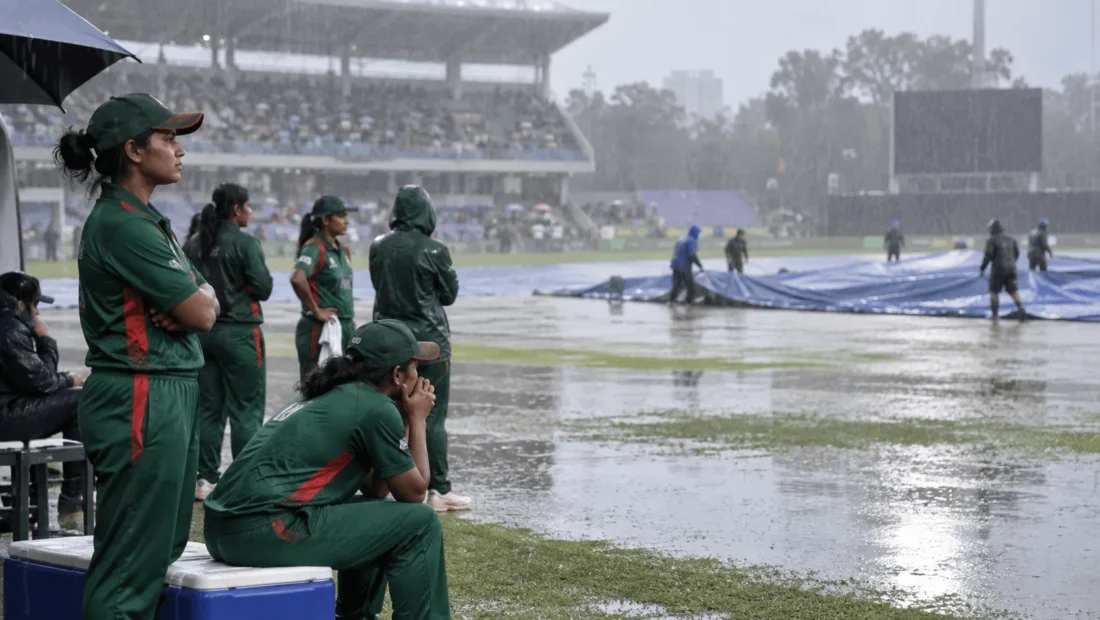
Bangladesh have reached the semi-finals of the 2026 Women’s Asian Games cricket competition after their quarter-final against China was abandoned without a ball being bowled. The opening knockout match was first delayed because of a wet outfield, and conditions never improved enough for the toss to take place. With no possibility of play, Bangladesh advanced on the basis of their higher seeding.
Bangladesh advance without a ball being bowled
The result is unusual because it sends one team into the last four without any on-field cricket in the quarter-final. There was no innings, no toss and no shortened contest. The tournament rules therefore pushed the decision back to the pre-existing seedings, which favoured Bangladesh.
For Bangladesh, the immediate consequence is simple: they are through to the semi-final on September 20. Their opponent will be the winner of India against Japan, the fourth quarter-final. That gives Bangladesh time to prepare, but it also means their first completed match of the tournament could come with a place in the final at stake.
How the quarter-final was lost to the weather
The Bangladesh-China game was scheduled as the first match of the women’s tournament on Thursday. The start was delayed by a wet outfield, and officials waited for conditions to improve. The delay eventually became an abandonment before the captains could even take part in the toss.
Because the match was a straight knockout, there was no league table or points calculation available to separate the teams. The higher seed therefore became decisive. Bangladesh moved forward and China were eliminated despite neither side having the opportunity to compete on the field.
That kind of result is one of the hardest outcomes in tournament cricket because it removes almost every sporting variable. Form, tactics and player performance never enter the equation. Instead, tournament structure and seeding decide the result.
The source does not indicate that a reserve day was available for the quarter-final. The published schedule continues with the remaining knockout matches and both semi-finals on September 20, followed by the final on September 22. With that compressed timetable, the abandoned game was resolved immediately rather than rescheduled.
The semi-final picture now taking shape
Bangladesh will face the winner of India versus Japan. That quarter-final is scheduled after Malaysia versus Sri Lanka on Friday, while Pakistan versus Thailand follows the Bangladesh-China washout on Thursday. Once those games are completed, the four semi-finalists will be known.
The women’s event began directly at the quarter-final stage, which means every match has elimination consequences from the start. Bangladesh’s route is therefore unusual: the team has effectively skipped the first competitive hurdle because weather prevented play.
The September 20 semi-final will be a much sharper test. If India advance, Bangladesh would face one of the strongest teams in the field. If Japan progress, Bangladesh would instead meet the host nation. The source does not speculate on which outcome is more likely, so the only confirmed point is that Bangladesh must prepare for either possibility.
The other side of the bracket is being shaped by Pakistan, Thailand, Malaysia and Sri Lanka. That structure matters because the tournament moves quickly from quarter-finals to semi-finals with little recovery time. Teams that do play their quarter-finals will have match practice, while Bangladesh will have freshness but no completed competitive game at the venue.
Korogi Sports Park hosts the tournament
All women’s matches are being played at Korogi Sports Park in Nisshin, Japan, on the outskirts of Nagoya. The same venue will host the semi-finals and final, so Bangladesh do not need to adapt to a new ground after the abandoned opener.
The wet outfield in the first quarter-final immediately made ground conditions part of the tournament story. It is too early to say whether weather will affect later matches, but the washout has already changed the competition by deciding one quarter-final through seeding.
From Bangladesh’s perspective, familiarity with the venue can still be useful even without completed play. The squad has gone through the match-day routine, assessed the conditions and seen how quickly the outfield can become a factor. Those observations are not a substitute for actual cricket, but they are the only on-site competitive experience available from the first scheduled game.
The men’s Asian Games cricket tournament begins later, on September 24, after the women’s final on September 22. That sequencing keeps the early part of the cricket programme focused entirely on the women’s knockout competition.
What the washout means for Bangladesh
The biggest advantage for Bangladesh is obvious: qualification. A place in the semi-final is secured without the physical and competitive risk of a quarter-final. Players avoid the possibility of injury or elimination, and the team can focus entirely on the next round.
There is, however, a different kind of challenge. Knockout cricket often rewards teams that settle into tournament conditions quickly, and Bangladesh have not yet had the chance to do that in a completed match. Their semi-final opponent will almost certainly arrive after playing at least one full or partial game.
That creates an unusual trade-off between freshness and rhythm. Bangladesh will have had more recovery time, while the opponent may have more recent match experience. Neither factor guarantees anything, but both help explain why a washout can be beneficial and awkward at the same time.
The source gives no indication of changes to Bangladesh’s squad or strategy after the abandonment. The practical task is therefore simple: monitor the India-Japan quarter-final, prepare for either opponent and make sure the team is ready for September 20.
The tournament now moves quickly
With the opening quarter-final resolved, the women’s Asian Games competition has little room for delay. Pakistan and Thailand complete Thursday’s programme, Malaysia and Sri Lanka play on Friday, and India face Japan in the final quarter-final. Both semi-finals then take place on September 20 before the gold-medal match on September 22.
Bangladesh’s progression is already one of the tournament’s defining early stories because it came without a toss. The higher seeding did exactly what seeding is designed to do in a weather-affected knockout: provide a predetermined method for separating teams when a match cannot produce a result.
For China, the outcome is harsh because elimination came without an opportunity to play. For Bangladesh, it is a valuable passage into the last four. The next match will remove the procedural safety net. From the semi-final onward, Bangladesh will need an on-field result if conditions allow.
Until the India-Japan game is completed, the only certainty is the date. Bangladesh will return on September 20 with a place in the Asian Games final on the line.
A place in the last four is confirmed, but nothing beyond it is
Bangladesh can treat the abandoned quarter-final as a completed step in the bracket, but the source gives no basis for assuming anything about the semi-final result. India and Japan still have to determine the opponent, and Bangladesh still have to produce a winning performance on September 20 if the weather allows a result. The washout therefore changes the route, not the final objective. It guarantees a last-four place and extra preparation time, while leaving the hardest part of the knockout path untouched: winning a semi-final and then, if successful, returning for the September 22 final.
The rest of the women’s schedule leaves little room for delay
The tournament calendar explains why the quarter-final could not simply drift into another day. Pakistan and Thailand were scheduled later on Thursday, Malaysia and Sri Lanka on Friday, and India and Japan in the final quarter-final. Both semi-finals are fixed for September 20, with the final only two days later on September 22.
In such a compressed knockout programme, one abandoned match can affect several later fixtures if organisers try to replay it. The source instead shows a structure in which higher seeding resolves the quarter-final and keeps the bracket moving. That may feel unsatisfactory for China, but it preserves the published dates for the rest of the event.
Bangladesh can now plan around a known semi-final date rather than waiting for a rescheduled quarter-final. They will also know their opponent only after India and Japan play, so preparation has to remain broad until that result is settled. The key certainty is that their next appearance is no longer a preliminary step. It is a direct opportunity to reach the Asian Games final.
Higher seeding becomes more than a line on the bracket
The washout shows why tournament seeding can matter even when it receives little attention before play starts. In a normal quarter-final, seeding influences the bracket but does not decide the winner. Here it became the tie-breaker because no cricket was possible. Bangladesh’s higher position therefore turned into a direct competitive advantage.
That does not mean Bangladesh were awarded a win in the ordinary sense. The match was abandoned, and the source describes their progression as a consequence of the tournament rules rather than a result achieved on the field. The distinction is important because it explains both why Bangladesh advance and why China leave the competition without a conventional defeat.
For the semi-final, the seeding advantage disappears. Bangladesh will meet whoever comes through India versus Japan, and progression to the final will depend on the next knockout match if conditions permit play. The quarter-final washout has therefore solved one stage of the bracket but has not reduced the pressure attached to the next game.
It also makes the September 20 semi-final Bangladesh’s first opportunity to show competitive form at the Asian Games. Training, preparation and knowledge of the venue can all help, but none produces the same information as a completed match. That makes the opening overs of the semi-final especially important as Bangladesh adjust to the tournament in real time.