
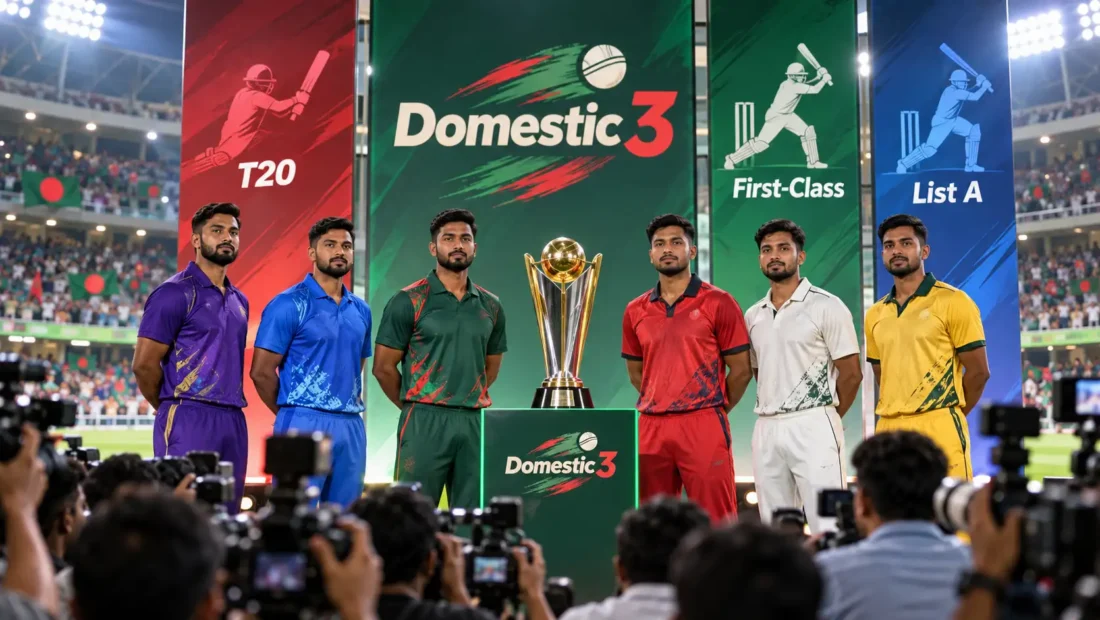
The Bangladesh Cricket Board has introduced a new franchise-based competition called Domestic 3, or D3, for the 2026-27 domestic season. The concept brings six privately owned teams into a structure that spans all three major formats rather than limiting the franchise model to T20 cricket. Each team is expected to play a T20 tournament, a first-class competition and a List A event during the season. The BCB has signed three-year agreements with the six franchise owners, giving the project a multi-season horizon from the start rather than presenting it as a one-off experiment.
Domestic 3 adds a franchise layer to the 2026-27 season
The board’s stated objective is to bring more colour back into domestic cricket. BCB president Tamim Iqbal used that phrase when explaining the purpose of the launch. The source does not define exactly how the board will measure success, but the design suggests several priorities at once: create recognisable franchise identities, attract commercial owners, give players a common team structure across formats and package existing competitions in a way that may be easier for supporters to follow. The important change is organisational rather than a completely new set of cricket formats.
Six companies have committed to the new competition
Six companies have purchased franchises for D3. Walton, a long-time BCB sponsor, is one of them, joined by Acme Laboratories, ACE Blue Star, Citizens Bank, Seven Rings Cement and Fortune Group. The report says each owner will pay BDT 2.5 crore per season, approximately US $203,283, with match fees included in that amount. Because the agreements run for three years, the structure gives the board and the teams a defined period in which to build the competition rather than renegotiating ownership after a single season.
The franchise model also gives domestic cricket a set of commercial identities that can be carried from one format to another. A team selected for the T20 competition will not disappear when the first-class tournament begins; the same franchise is expected to participate across the entire D3 programme. That continuity is unusual compared with systems where red-ball, one-day and T20 competitions use different team identities. It may make the season easier to understand for supporters because the same six organisations can be followed through several types of cricket.
| Franchise owner | Icon player named by BCB | Three-format participation |
|---|---|---|
| Walton | Mehidy Hasan Miraz | T20, first-class and List A |
| Fortune Group | Towhid Hridoy | T20, first-class and List A |
| Acme Laboratories | Mosaddek Hossain | T20, first-class and List A |
| Seven Rings Cement | Mushfiqur Rahim | T20, first-class and List A |
| ACE Blue Star | Nurul Hasan | T20, first-class and List A |
| Citizens Bank | Mohammad Naim | T20, first-class and List A |
The first D3 season is planned around three separate windows
D3 is expected to begin with the T20 tournament, likely from December 15. The first-class competition is scheduled to follow in January, with the one-day event planned for May. That sequence spreads the franchise programme across a significant portion of the domestic calendar. The source uses provisional language around the T20 start, so December 15 should be treated as the likely opening date rather than a final fixture list. The January and May windows are also described at a broad scheduling level rather than through a complete set of matches.
Spacing the formats across the season gives the franchises time to adjust between competitions, but it also means team planning has to cover very different cricket demands. A T20 squad needs explosive batting, specialised death bowling and short-form tactical options. First-class cricket places greater value on endurance, long spells and batting concentration. List A cricket sits between those extremes. D3 therefore asks each franchise to build a 23-player group capable of handling all three rather than assembling a narrow squad for one tournament.
Team-management and player drafts will shape the six squads
The BCB is using drafts for both management staff and players. A management draft is scheduled first, with franchises able to bid for their preferred coaches. A player draft is then planned for the following month. Each team must select 23 cricketers to cover the three formats. That two-stage process gives the owners an opportunity to establish a coaching structure before completing the playing group, which may allow teams to choose players with a clearer idea of the style and balance their staff want.
The source does not provide draft-order rules, salary bands or detailed roster restrictions, so those elements should not be assumed. What is confirmed is the scale of the squads and the requirement to operate across formats. Twenty-three players is large enough to support rotation and specialist roles, but small enough that selection decisions will matter throughout the season. The franchise concept will therefore be tested not only by match results but also by how effectively each organisation builds a multi-format roster from the domestic talent pool.
Icon players give every franchise an immediate cricket identity
The board has already attached one prominent player to each franchise as an icon. Mehidy Hasan Miraz is linked with Walton, Towhid Hridoy with Fortune Group, Mosaddek Hossain with Acme Laboratories, Mushfiqur Rahim with Seven Rings Cement, Nurul Hasan with ACE Blue Star and Mohammad Naim with Citizens Bank. Naming those players before the wider draft gives each team a recognisable cricketing figure around whom early promotion and squad planning can be built.
The icon list also covers different roles and career profiles. The source does not explain whether the players were directly selected by owners, allocated by the board or chosen through another mechanism, so the allocation process should not be inferred. What matters for the launch is that every franchise begins with a known player rather than a blank roster. That can help the competition establish identity before the full squads are drafted and before team-management appointments are completed.
D3 will combine competitions that previously sat in separate structures
One of the most significant parts of the plan is that D3 will bring together competitions associated with the Bangladesh Cricket League’s first-class and List A programmes and the NCL T20s. The board is therefore not simply adding three entirely new tournaments on top of everything already in the calendar. It is regrouping existing domestic formats under a franchise framework. That distinction matters because the project can change presentation, ownership and team identity without necessarily increasing the total amount of cricket by the same scale.
For players, the change could create a more continuous team environment across formats. For supporters, it may reduce the fragmentation that can occur when different competitions have different structures and identities. The source does not yet describe venues, broadcast arrangements or branding for the six teams, so the practical fan experience remains to be seen. Still, the concept is clearly designed to make three domestic competitions feel like parts of one larger product rather than unrelated events scattered through the season.
The traditional regional season will still begin in October
D3 does not replace the entire domestic system. Bangladesh’s season is set to begin on October 3 with the NCL first-class competition, which remains region-based and includes the country’s eight divisions. That means the new franchise model will exist alongside the established regional structure rather than immediately taking over every level of domestic cricket. The distinction may be useful for player development because regional and franchise competitions can serve different purposes within the same season.
The October NCL start also gives players competitive red-ball cricket before D3 begins in December. The source does not spell out selection links between the two systems, but the timing means form in the early domestic season could become relevant ahead of the franchise competitions and player draft. The board is effectively creating an additional layer rather than a single replacement league, and the relationship between those layers will become clearer once squads, fixtures and team management are finalised.
The three-year agreements make D3 more than a short promotional test
A three-year commitment is long enough for owners to develop a team identity, but short enough for the BCB to review the model before treating it as permanent. The reported BDT 2.5 crore annual payment gives each franchise a defined financial obligation, while the inclusion of match fees suggests part of the operational cost is built into the arrangement. The source does not provide revenue forecasts, sponsorship projections or profit expectations, so it would be speculative to describe the competition as commercially secure before it has begun.
What can be said is that the BCB has designed D3 with more structure than an exhibition tournament. There are six named owners, icon players, multi-format squads, management and player drafts, three competition windows and three-year deals. Those components create a framework that can be evaluated over time. The first season will show whether the franchise identity makes domestic cricket easier to market and whether the same teams can remain meaningful to supporters when they move from T20 to first-class and then to one-day cricket.
The launch is an attempt to make domestic cricket more visible
Tamim Iqbal’s comment about bringing colour back to domestic cricket captures the board’s broad ambition. The challenge for many domestic competitions is not the quality of the cricket alone but whether supporters can identify with teams, understand the calendar and recognise the players involved. D3 addresses that problem through branding and continuity. Six franchises, each with an icon player and the same identity across formats, create a simpler narrative than three disconnected competitions with different structures.
The idea will still depend on execution. Draft rules, scheduling, venues, broadcast access and competitive balance will all influence whether the franchise layer feels meaningful. Those details are not yet included in the supplied report. At launch, the confirmed story is the structure itself: Bangladesh is creating a six-team, all-format franchise competition with private owners, three-year agreements and a calendar that begins with T20 cricket before moving through first-class and List A tournaments.