
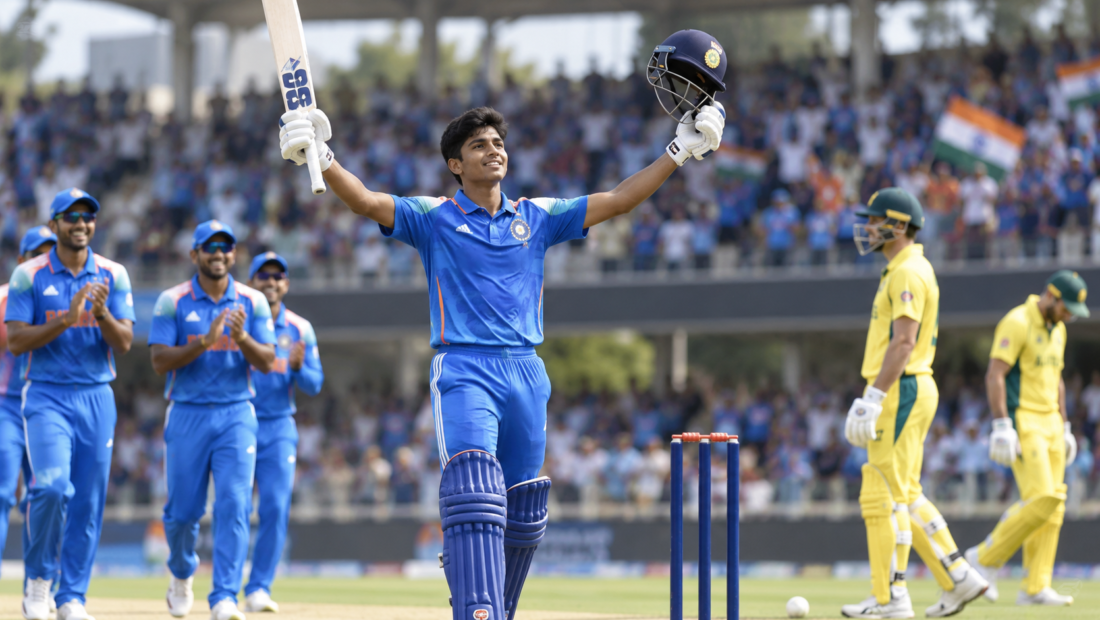
Yashbardhan Chauhan produced the defining all-round performance as India Under-19 defeated Australia Under-19 by 103 runs in Rajkot and secured the three-match Youth ODI series with one game still to play. India made 341 for 7 after being asked to bat first, with Chauhan scoring 122 from 100 balls. Australia replied with 238 and were bowled out in 41.1 overs.
Chauhan drives India to a series-clinching win
| Team | Score | Key performers |
|---|---|---|
| India Under-19 | 341/7 | Yashbardhan Chauhan 122; VK Vineeth 87; Aaryavir Sehwag 47 |
| Australia Under-19 | 238 all out | Jack Czosnek 81; Blake Cattle 44; Matthew Lough 42 |
| Result | India won by 103 runs | India sealed the series with one game to spare |
Chauhan then added 2 for 56 with the ball, turning an already important batting contribution into a complete match performance. His century was also his second fifty-plus score in as many games, showing that the innings was part of a strong start to the series rather than an isolated result. The margin of victory was comfortable in the end, but the match still contained periods when Australia had a route back into the contest, particularly during a 99-run partnership in the chase. India repeatedly found the wicket that stopped those moments from becoming a sustained recovery.
A 122 that shaped the entire first innings
Chauhan’s 122 came from exactly 100 balls and included 15 fours and two sixes. The innings gave India a stable centre while other batters played around him at different tempos. Aaryavir Sehwag contributed 47 from 48 balls at the top of the order, helping create a platform before Chauhan and VK Vineeth took control. The third-wicket partnership between Chauhan and Vineeth was worth 132 runs and became the key stand of the innings. It gave India both volume and time: enough runs to move toward a large total and enough wickets in hand to attack later. Chauhan’s scoring rate meant he did not have to choose between occupying the crease and keeping the board moving. By the time Vineeth was dismissed in the 40th over, India were 233 for 3 and well placed to turn a strong foundation into a total above 300.
Vineeth provides the ideal support
VK Vineeth made 87 from 92 balls, striking four fours and six sixes. The distribution of boundaries is interesting because it shows a different route to scoring from Chauhan’s. Chauhan hit more fours, while Vineeth cleared the boundary more often. Together they gave Australia few quiet periods in the middle of the innings. Their 132-run stand also protected India from the kind of cluster of wickets that can stall an Under-19 innings after a promising start. When Vineeth fell in the 40th over, India still had enough batting left to accelerate. That was important because a score in the 260-280 range would have left Australia a very different chase. Instead, the platform built by the third-wicket pair allowed the final ten overs to become an attacking phase. The partnership was therefore valuable not only for the runs it produced directly, but for the options it created later.
India add 106 in the final ten overs
The closing phase turned a strong score into a commanding one. India added 106 runs across the last ten overs, with Chauhan continuing his innings and Kushagra Ojha providing a sharp late burst. Ojha scored 34 from 20 balls, hitting five fours and a six. That contribution ensured Australia did not get relief immediately after the long Chauhan-Vineeth partnership ended. Instead of rebuilding, India were able to keep increasing the scoring rate. The result was 341 for 7, a total that required Australia to maintain pressure almost from the start of the chase. Thomas Vaseo was the most successful visiting bowler with 3 for 78 from his ten overs. Taking three wickets gave Australia some breakthroughs, but the cost of 78 runs reflected the difficulty of containing an innings where multiple Indian batters were able to sustain or increase the tempo.
Australia’s chase begins with setbacks
Australia Under-19 never fully matched the required rate, although the innings was not without resistance. They slipped to 72 for 3 before captain Jack Czosnek and Matthew Lough put together the partnership that briefly reopened the game. Lough made 42 from 40 balls, while Czosnek scored 81 from 63 deliveries with seven fours and four sixes. Their fourth-wicket stand was worth 99. For a period, it gave Australia a base from which a larger chase could be imagined. Czosnek’s scoring rate was particularly important because a target of 342 does not allow a batting side to spend too many overs merely consolidating. The partnership balanced recovery with enough aggression to keep the innings relevant. India’s challenge at that stage was to break the stand before the required equation became manageable for the middle order.
Czosnek’s wicket changes the chase
The turning point came in the 27th over when Kavya Paresh Patel dismissed Czosnek. Australia had relied heavily on their captain to keep the chase moving, so losing him at 81 removed both the best-set batter and the player scoring quickly enough to challenge the target. Blake Cattle continued the resistance with 44 from 46 balls, but wickets kept falling around him. Australia eventually lost their last six wickets for 38 runs and were bowled out for 238 in 41.1 overs. The collapse made the final margin look emphatic, but it was created by a sequence of bowling contributions rather than a single spell. Once India ended the Czosnek-Lough partnership and prevented another substantial stand from forming, the required rate and the shrinking wicket count began working together. The visitors were left needing both acceleration and survival at the same time.
Venkata leads a balanced bowling effort
Chigurupati Venkata finished as India’s leading wicket-taker with 3 for 64. Chauhan followed his century with 2 for 56, while Kavya Paresh Patel returned the most economical figures at 2 for 23 from seven overs. Mohit Ulva added 1 for 19 from seven. The spread of wickets is important because it shows India did not depend on one bowler to finish the match. Venkata took the most wickets, Patel controlled the scoring and Chauhan added two dismissals to his batting contribution. That balance becomes especially valuable in youth cricket, where one difficult spell can otherwise put heavy pressure on the rest of the attack. India were defending a large total, but Australia still had enough batting to punish loose bowling. Keeping the chase below the required rate while continuing to take wickets was the task, and the attack managed both.
Why Chauhan’s all-round contribution stands out
A century alone would have made Chauhan the central figure in the match. Adding two wickets made the performance harder to separate from the final result. He was involved in the most productive batting phase, stayed long enough to help India reach the final acceleration and then contributed with the ball after Australia began their chase. His 122 accounted for more than a third of India’s total, while his bowling figures added another direct influence on the opposition innings. The source also notes that this was his second fifty-plus score in consecutive games. That sequence is significant inside a three-match series because consistency over two matches can decide the contest before the final fixture is played. India now hold the series with one match remaining, so Chauhan’s form has already had a result beyond individual statistics. It has helped remove the series from Australia’s reach.
India’s batting phases worked together
The innings can be divided into three useful phases. Sehwag’s 47 helped India begin without losing momentum at the top. Chauhan and Vineeth then produced the large third-wicket stand that controlled the middle overs. Finally, Chauhan and the lower middle order, especially Ojha, turned that platform into 106 runs from the last ten overs. None of those phases had to carry the innings alone. That is one reason the final total reached 341 rather than stopping at a merely competitive score. Australia managed wickets, with Vaseo taking three, but never found a sustained period where India’s scoring and wicket preservation both collapsed. In response, the visitors had only one partnership of comparable influence: the 99 between Czosnek and Lough. Once that ended, there was no second stand capable of maintaining the chase.
Series secured with a match still available
The 103-run result gives India Under-19 the Youth ODI series before the final game. That changes the immediate pressure around the remaining fixture, but the second match still offers both teams useful information. India can look at whether the batting depth and bowling balance continue to hold, while Australia have to address how quickly the chase fell away after Czosnek’s dismissal. The defining image of this game, though, remains Chauhan’s all-round performance. His 122 gave India the foundation for 341 for 7, and his two wickets helped make sure the chase never recovered after the middle-overs resistance. With Vineeth’s 87, Sehwag’s 47, Ojha’s late 34 and a shared bowling effort around him, the result was not a one-player victory. But Chauhan was the player who connected the two innings most clearly, and that is why the series-clinching win carries his name at the centre of the story.
The result leaves India with several positives beyond the headline century
Chauhan was the obvious player of the match, but the scorecard also shows why India were able to turn his performance into such a large victory. Vineeth gave the century-maker a long partner through the middle overs, Sehwag contributed at the top and Ojha ensured the innings did not slow in the final phase. With the ball, Venkata, Patel and Ulva shared responsibility rather than leaving the defence to one bowler. That distribution matters when reading a 103-run margin because large wins can sometimes hide a dependence on one exceptional contribution. Here, Chauhan was exceptional, but the rest of the side repeatedly converted his work into match control. Australia had their own strong individual performances through Czosnek, Lough and Cattle, yet the visitors could not build a second major partnership once the 99-run stand ended. India, by contrast, linked one strong phase to the next. With the series already secured, that collective shape may be as useful to the team as the result itself.