
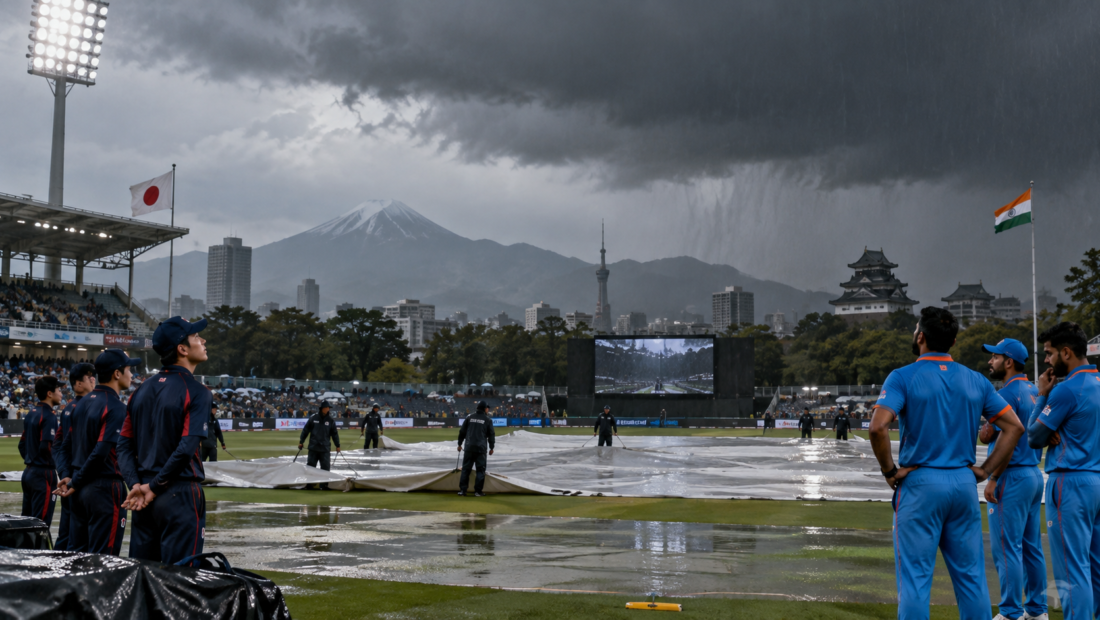
Japan are preparing for one of the most unusual fixtures in their international history: a one-off T20I against India in Sano while the Indian team is in Japan for the Asian Games. The contrast between the two sides is part of what makes the match notable. India arrive as world champions and as one of the most prominent teams in the sport, while Japan are still much farther from regular top-level competition.
A rare cricket occasion for Japan
The source draws a historical parallel with the 1930 Australian Ashes tour, when the touring side stopped in Ceylon and Don Bradman played there decades before Sri Lanka became an international force. The comparison is not about saying the two cricket environments are identical. It is about the rarity of a global star team appearing in a place that does not often host this level of opposition. For Japan’s players, the match offers direct exposure to the routines, techniques and decision-making of an elite side.
Japan have already made 2026 a significant year
The fixture does not come out of nowhere for Japan. During the Super Six stage of the T20 World Cup East Asia-Pacific Qualifiers, they beat Papua New Guinea, a side that has appeared at two T20 World Cups and later went on to win the qualifier. That result gave Japan a credible achievement to carry into the home meeting with India. Their recent completed T20I form reads LWWLW, while India arrive on a five-match winning run. The gap in reputation remains enormous, but Japan are not approaching the game without recent evidence that they can produce competitive performances. The source frames the India match as a chance to watch global stars at close range and, if circumstances allow, test whether the hosts can make the contest uncomfortable. Even a brief period of pressure against India would give the home side something tangible from an occasion that is already unusual simply because it is taking place.
Kendel Kadowaki-Fleming leads the home story
Japan captain Kendel Kadowaki-Fleming is the central figure in the home side. The 30-year-old, whose mother is Japanese and father Australian, is Japan’s highest run-scorer in international cricket. Alongside opener Lachlan Yamamoto-Lake, he also shares the record for the largest partnership for any wicket in any T20 match after the pair took Japan to 258 for 0 against China in 2024. Those numbers make Kadowaki-Fleming the obvious player around whom Japan’s batting story is built. He moved himself down to No. 3 in the first match of the series against Hong Kong on the weekend before the India fixture, so one selection question is whether he stays in that position. Against India, where the quality and variety of the bowling attack will be far greater than Japan normally face, the captain’s role will extend beyond scoring runs. He also has to help the group manage the occasion itself.
Bumrah offers a challenge Japan rarely gets
At the other end of the matchup is Jasprit Bumrah. The source describes the prospect of facing him as both difficult and unusual for an international batter outside the regular top-level circuit. India have been managing his workload carefully because of his injury history, but he has also shown a desire for game time, including by playing the dead rubber against Afghanistan. If he takes the field in Sano, Japan’s batters will get a direct look at one of the world’s most demanding fast-bowling tests. For Kadowaki-Fleming in particular, the contest has obvious symbolic value. Most players in emerging cricket nations can study top bowlers on video, but very few get the chance to face them in an official international. That is one reason the weather forecast matters so much. Losing the game would remove not only a result but a rare developmental experience that cannot be reproduced in training.
India face their own selection questions
India’s likely XI reflects a change in coaching context. Under Gautam Gambhir, the side had recently used three allrounders, giving themselves batting depth down to No. 8 even if that slightly reduced the number of specialist bowlers. For the Japan trip, VVS Laxman is back as head coach. The source notes that he used four specialist bowlers in Zimbabwe, so the balance of the XI is worth watching. The listed India side includes Abhishek Sharma, Sanju Samson as wicketkeeper, Ishan Kishan, captain Shreyas Iyer, Tilak Varma, Axar Patel, Nitish Kumar Reddy, Shivam Dube, Ravi Bishnoi, Arshdeep Singh and Jasprit Bumrah. It is a lineup with substantial batting power as well as multiple bowling options. Against Japan, the selection question is less about finding enough quality and more about how India want to distribute roles while keeping players involved during the Asian Games period.
Japan have a settled core of their own
Japan’s listed XI is Lachlan Yamamoto-Lake, Reo Sakurano-Thomas, Kendel Kadowaki-Fleming, Benjamin Ito-Davis, Charlie Hara-Hinze, Ibrahim Takahashi, Alester Kadowaki-Fleming, wicketkeeper Wataru Miyauchi, Declan Suzuki, Makoto Taniyama and Shoma Sugaya-Slater. The presence of a familiar group matters because the hosts are not being assembled purely for the spectacle of facing India. They are an established international team with a 41-19 T20I win-loss record. The difference is the level of opposition. India bring a depth of experience and a recent five-match winning sequence that places the home side in a very different competitive environment. For Japan, the challenge is to keep the match within the routines they already know: build partnerships, protect wickets, create pressure with the ball and avoid allowing the occasion itself to make basic decisions more complicated than they need to be.
The biggest opponent may be the weather
All of the cricket discussion depends on the conditions in Sano. Heavy rain fell in the city the day before the match and forced the cancellation of India’s training session. The same problem had already affected Japan’s schedule: their match against Hong Kong on September 20, two days before the India fixture, was abandoned without a ball bowled. The source describes drainage as a major test for the venue. That creates a frustrating scenario for Japanese cricket. The sport has succeeded in bringing India to Sano for a one-off T20I, but the weather could prevent the home players and spectators from seeing the event develop properly. Ground staff therefore become an important part of the story. Even if the rain stops, the outfield has to be safe and dry enough for play. A clear sky at match time does not automatically remove the effect of heavy rain from the previous day.
Abhishek Sharma adds another attacking dimension
India also arrive with Abhishek Sharma in exceptional scoring form. The source notes that, among players with at least 20 T20I innings since his debut in July 2024, nobody has scored faster than his strike rate of 194.55 runs per 100 balls. That number adds another layer to Japan’s task. The home bowlers are not only trying to contain established names; they are facing an opener whose recent international scoring rate has been unusually aggressive. Early wickets would therefore have value beyond the scoreboard because they could prevent India from settling into the kind of high-tempo innings that quickly moves a match out of reach. For Japan, the opening overs may be the most important phase of the contest if it goes ahead. For India, they offer another chance to let an attacking top order play with freedom while the team continues to refine combinations.
What the fixture can offer even before the result
A one-off international against India gives Japan something that ordinary bilateral results cannot fully capture. Their players can observe preparation at close range, experience the speed of decision-making against elite opposition and test their own methods under a level of pressure that is difficult to simulate. The source is careful not to overstate Japan’s position in the global game, describing them as still far from top-flight cricket. That is precisely why the fixture matters. Exposure is not the same as development, and one match cannot transform a national programme, but it can provide a reference point. Players learn what a higher standard feels like in real time. Coaches can see which skills hold up and which areas break down. Supporters also get a clearer sense of the gap between a growing international side and the world champions.
For Japan, getting on the field is the first victory
The final uncertainty is therefore basic: will the weather allow the game to happen? Japan have already had one match abandoned in the same week, and India’s training was washed out. If conditions improve, the hosts will get the rare opportunity the schedule promised. Kadowaki-Fleming can test himself against Bumrah, Japan’s bowlers can try to contain an Indian lineup built around attacking batters, and a local crowd can watch top-level T20 cricket in Sano. If the rain wins again, the disappointment will be larger than the loss of a routine bilateral fixture because this particular opponent may not return quickly. India captain Shreyas Iyer described the first meeting with Japan as an exciting occasion. The sentiment is easy to understand. For Japanese cricket, the immediate hope is simply that the skies stay clear long enough for that occasion to become an actual match rather than another abandoned entry in the schedule.
A small venue carrying a much bigger moment
The setting in Sano is part of what gives the fixture its character. India are not visiting Japan for a long bilateral tour built around several matches; they are taking a detour during the Asian Games period for a single T20I. That makes the opportunity unusually concentrated. Japan may have only one evening to measure themselves against this level of opposition, and the weather has already taken away preparation time. The abandoned Hong Kong match and cancelled India training session make the forecast a competitive issue rather than background detail. If play is possible, both sides will enter with less ideal preparation than planned, although the consequences are naturally greater for the hosts because of how rare the occasion is. Japan’s 41-19 T20I record shows that they are already used to international competition. What they do not often receive is an opponent with India’s depth, current form and individual quality. That is why even a shortened but completed match would still carry considerable value for the home side.