
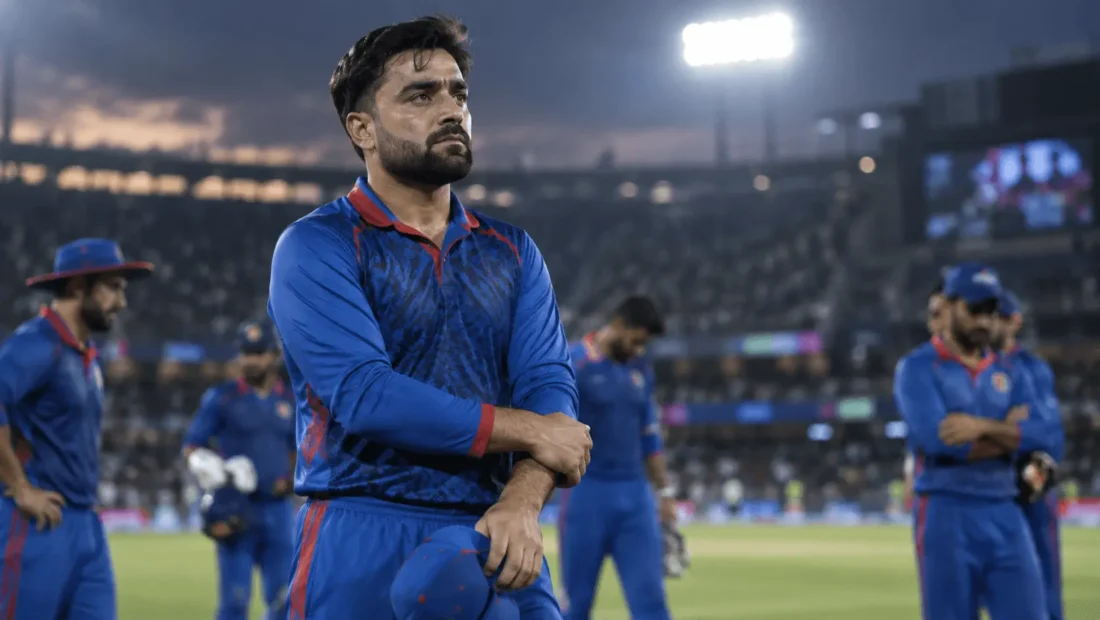
Rashid Khan says he was not informed by the Afghanistan Cricket Board before being removed as the country’s T20I captain earlier in 2026. The change came after Afghanistan failed to progress beyond the group stage of the T20 World Cup, with opening batter Ibrahim Zadran taking over the leadership role.
Speaking in an interview with Cricinfo facilitated by Red Bull, Rashid said he learned about the decision only when the board announced it publicly. His comments do not challenge Zadran’s appointment directly, but they do make clear that the communication around the captaincy change came as a surprise to the former skipper.
Rashid says the decision was outside his control
“Even I don’t know what exactly happened at that time,” Rashid said when discussing the change. He added that he came to know about it when the board made its announcement. That is the central point in his account: he was the captain, but he was not part of the conversation that ended his tenure.
The timing followed Afghanistan’s disappointing 2026 T20 World Cup campaign. The team did not get beyond the group stage, and the captaincy was subsequently moved to Zadran. Results in a major tournament naturally bring leadership decisions under scrutiny, but Rashid’s record across his wider spell provides more context than the World Cup alone.
He led Afghanistan in 48 T20 internationals, winning 26 and losing 22. According to the source, only Asghar Afghan finished with a better win-loss ratio as Afghanistan captain, although part of Asghar’s tenure came during a period when Afghanistan more frequently faced lower-ranked opponents.
The 2024 World Cup semi-final remains a major part of his record
Rashid’s captaincy included Afghanistan’s run to the semi-finals of the 2024 T20 World Cup, one of the strongest results of his leadership period. He also referenced a series win over West Indies when discussing what the side achieved under him.
Those results help explain why his removal was not simply received as an obvious change after one disappointing event. The 2026 World Cup was poor, but the preceding period contained major progress. A captain who had taken Afghanistan to a World Cup semi-final had also demonstrated that the team could compete deep into a global tournament.
Rashid himself used that history to place the decision in perspective. He noted the semi-final and the win over West Indies, then added that some things are not in a player’s control. That framing is important because he did not present the interview as a campaign to regain the captaincy. Instead, he repeatedly returned to what he can still influence as a player.
Moving on from the captaincy question
Rashid said he has moved on and remains proud to represent Afghanistan whether he is captain or not. His focus, in his own words, is to use his skills and capabilities to help the team win. That is a familiar message from a senior player after a leadership change, but it carries extra weight here because he says the decision itself was never explained to him beforehand.
The captaincy therefore creates two separate issues. One is the board’s decision to make a change after the World Cup. The other is the communication with the outgoing captain. Rashid’s comments are strongest on the second point. He does not claim to know the full reasoning because, according to him, he was not told what exactly happened.
That leaves the public explanation centred largely on timing: Afghanistan failed to advance from the World Cup group stage, and Zadran was appointed afterward. Anything more detailed than that is not provided in the source, which makes Rashid’s uncertainty part of the story rather than something that can be neatly resolved.
Ibrahim Zadran begins his full-time tenure
The recent three-match series against India was Zadran’s first assignment as full-time T20I captain. Afghanistan lost all three games. The result means the new leadership period began with a difficult series, although three matches are a very small sample compared with Rashid’s 48-game record.
Zadran’s appointment also changes Rashid’s role without reducing his importance to the XI. He remains one of Afghanistan’s senior players and a central bowling option. The captaincy may have moved elsewhere, but the side still depends heavily on his performance and experience.
Against India, Rashid took 4 wickets for 113 runs across the series and conceded at an economy rate of 9.82. Those figures came during a 3-0 defeat, making it a challenging first series for the new captain and for the team as a whole.
Rashid’s numbers as captain deserve context
A 26-22 record from 48 T20Is gives Rashid more wins than losses as captain. That is notable because international captaincy records can be shaped heavily by opponent strength, tournament format and the quality of the team available at different stages.
The source specifically adds context around Asghar Afghan, the only Afghanistan captain with a better win-loss ratio. His tenure overlapped with a period in which Afghanistan often played lower-ranked teams. That does not reduce those wins, but it makes direct comparisons between leadership eras less simple than the raw percentages suggest.
Rashid’s period also included the 2024 World Cup semi-final, which is a tournament achievement rather than merely a bilateral-series statistic. Reaching the final four provided evidence that Afghanistan under his leadership could convert their talent into a sustained run against major opposition at a global event.
The 2026 World Cup changed the mood
The contrast with 2026 is sharp. Afghanistan did not progress beyond the group stage, and the captaincy changed soon after. Major tournaments often concentrate attention because there is little room to recover from a few poor results. A team can arrive with a strong record and still leave facing structural questions if it exits earlier than expected.
The board’s decision therefore came in a recognisable performance context even though Rashid says the internal reasoning was not communicated to him. The World Cup result provided an obvious moment for a review, and Zadran’s appointment created a new leadership direction.
What Rashid’s comments add is a reminder that formal changes can look different from inside the team. From the outside, the sequence is simple: poor World Cup, new captain. From Rashid’s perspective, there was a missing conversation between those two events.
Leadership changes do not remove senior responsibility
Rashid’s response suggests he is separating the title from his responsibility as a senior player. Captaincy gives one player the formal role, but experience still exists throughout a squad. A former captain can continue to influence preparation, bowling plans and pressure situations even when the final decisions belong to somebody else.
That may be particularly useful for Zadran as he settles into the job. His first full-time series ended 3-0, and Afghanistan now have to adjust to a new leadership structure without losing the contributions of the player who led them to a World Cup semi-final two years earlier.
Rashid’s public message is that he intends to keep contributing rather than dwell on the title. He said what he can control is performing well for Afghanistan and helping the team win. The wording is simple, but it draws a clear line between the boardroom decision and his own role on the field.
The communication question remains unanswered
The most unresolved part of the story is still why Rashid was not informed directly before the announcement. His interview does not provide the board’s explanation, and the source does not include a response from the Afghanistan Cricket Board on that point.
That means the captaincy change should not be overinterpreted beyond what is known. Afghanistan changed leaders after a disappointing World Cup, Ibrahim Zadran became captain, and Rashid says he learned about the decision through the public announcement. The deeper process behind that decision remains unclear from the material available here.
For now, Rashid appears to have accepted the new structure even if he does not fully understand how it was reached. He can point to 26 wins from 48 matches, a 2024 World Cup semi-final and other positive results from his tenure. At the same time, the 2026 tournament ended early and the board chose a different captain.
The contrast between the old and new leadership periods will probably remain part of the discussion because Rashid’s tenure produced both a major tournament breakthrough and a disappointing final campaign. His 48-match record gives the previous era a substantial body of results, while Zadran is only at the beginning of his own sample. The source does not offer enough evidence to judge the new captaincy after one three-match series, but it does show how quickly expectations can shift after a World Cup exit.
Rashid’s own statistics in the India series also underline that the captaincy change has not separated him from the pressure around team performance. Four wickets for 113 runs at 9.82 per over are part of the same 3-0 defeat that marked Zadran’s first full-time series. Afghanistan need improvement collectively, and Rashid remains one of the players most likely to influence that improvement even without the title.
The next stage is therefore less about revisiting the decision and more about how Afghanistan perform under Zadran with Rashid still central to the team. The first series did not go well, but the leadership transition is only beginning. Rashid’s own position is clear: captain or not, he wants his contribution to be measured by what he can still do for Afghanistan on the field.