
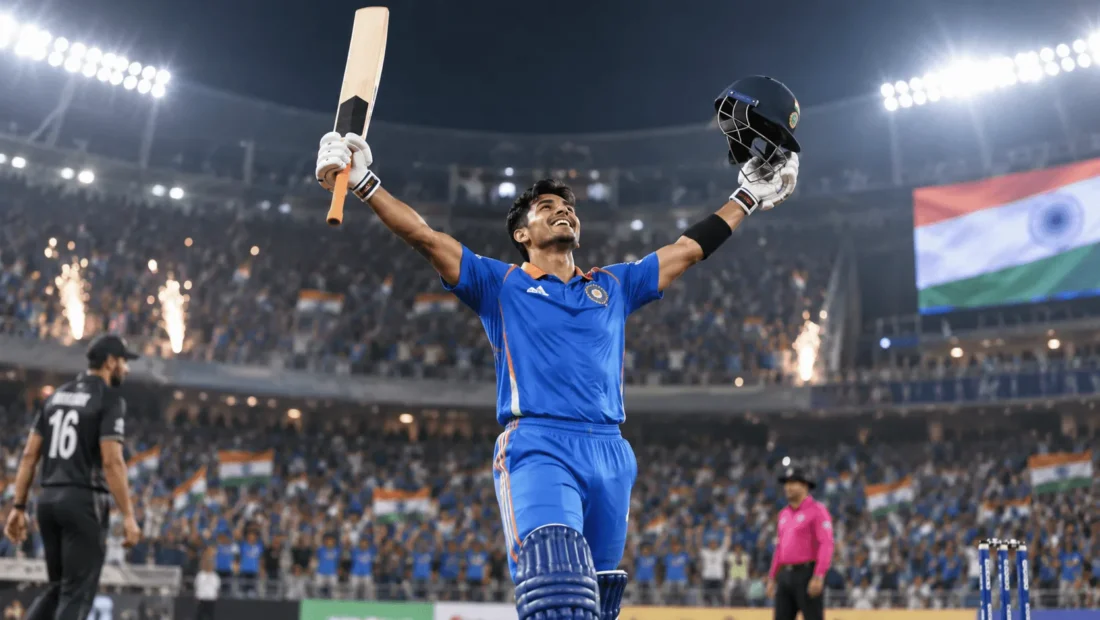
Abhishek Sharma has produced one of the fastest innings in international cricket, reaching a T20I hundred from only 30 balls in India’s third match against Afghanistan in Delhi. The innings set a new record for the fastest century by a batter representing a Full Member nation.
The previous Full Member benchmark was 33 balls, jointly held by Zimbabwe’s Sikandar Raza and New Zealand’s Finn Allen. Raza reached his hundred against Gambia in 2024, while Allen matched the mark against South Africa at the 2026 T20 World Cup. Abhishek reduced that record by three deliveries.
A 30-ball century rewrites the Full Member record
He also comfortably beat India’s previous national record. Rohit Sharma had held that mark with a 35-ball hundred against Sri Lanka in 2017. Abhishek’s 30-ball effort therefore reset both the Indian record and the wider Full Member standard in the same innings.
The overall T20I record remains with Sahil Chauhan, who made a 27-ball century for Estonia against Cyprus in 2024. Abhishek’s knock sits just behind that performance while carrying the distinction of being the fastest by a batter from a Full Member team.
How Abhishek accelerated from fifty to a hundred
The shape of the innings makes the record even more striking. Abhishek needed 16 balls to reach his first fifty, which is already an exceptional scoring rate. Instead of slowing after the milestone, he became even more aggressive and scored the next fifty runs in only 14 balls.
That second phase is what pushed the innings into record territory. A century in 30 balls means there was almost no period of consolidation. The acceleration continued through the middle of the power-hitting burst until the hundred was complete.
He eventually finished with 108 from 34 balls. The innings included nine fours and 11 sixes, giving him 20 boundaries in total. The source notes that he hit a six once every 3.09 balls, a statistic that captures how consistently he was able to clear the rope.
The distribution of boundaries also shows that the innings was not built only around one scoring option. Eleven sixes provided the biggest jumps, but nine fours added another 36 runs. Together, those boundaries accounted for the overwhelming majority of his total.
India’s innings was dominated by one batter
At the moment Abhishek was dismissed in the tenth over, India were 142 for 1. He had scored 108 of those runs, meaning he was responsible for just over 76% of the team total at that point.
That share is a useful way to understand the scale of the innings. Sanju Samson, his opening partner, contributed 34 from 25 balls to the partnership. Samson’s contribution was valuable in maintaining the stand, but Abhishek’s scoring rate turned the partnership into something extraordinary.
The source does not provide India’s final total or the eventual result of the match, so the record should be assessed on the information available at the time of his dismissal. By then, he had already transformed the innings and established a new Full Member benchmark.
A player scoring more than three quarters of the team’s runs deep into the first half of a T20 innings also creates pressure on the bowling side in a specific way. Afghanistan were not simply conceding boundaries across the lineup; one batter was repeatedly winning the matchup and forcing the fielding side to respond.
Where the innings places him among India’s T20I centurions
This was Abhishek’s third T20I hundred. Among India batters, only Rohit Sharma and Suryakumar Yadav have scored more centuries in the format. Rohit has five and Suryakumar has four, placing Abhishek immediately behind them on the national list given in the source.
That is notable because century counts in T20 cricket are difficult to build. The format gives batters limited time and often requires risk from the first few overs. Reaching three international hundreds therefore already places Abhishek in a relatively small group of Indian players with repeated three-figure scores.
The latest innings also stands apart from his earlier hundreds because of the speed. A 30-ball century is not just another entry in his career statistics; it is a record that changes where he sits in the history of Full Member T20I batting.
The comparison with Rohit is especially clear. Rohit’s 35-ball century remained India’s record for years. Abhishek did not edge past it by one delivery. He cut five balls from the mark, a substantial gap at this scoring rate.
The record arrived while Abhishek was already highly ranked
Before the Afghanistan match, Abhishek had risen to No. 2 in the ICC T20I batting rankings. Only India team-mate Ishan Kishan was above him. That ranking provides useful context because the record did not come from a player suddenly producing one isolated innings after a quiet period. He entered the match already positioned among the highest-rated T20I batters.
The century strengthens the narrative around his current form, although the ranking itself will only change through the official update process. The source does not provide a new post-match ranking, so it would be inaccurate to assume where the innings will place him next.
What can be said is that a player ranked second in the world has now added a record-breaking hundred. That combination makes the innings relevant both historically and in the immediate competition for places and status within India’s T20 setup.
It also increases the contrast with the older national benchmark. Rohit Sharma’s 2017 record came from a previous generation of India’s T20 side. Abhishek’s 2026 innings reflects how far scoring rates at the top level continue to be pushed.
Fastest does not mean overall fastest in every T20I
The record needs one qualification. Abhishek now owns the fastest T20I hundred by a batter from a Full Member country, but he does not hold the overall international record. Sahil Chauhan’s 27-ball century for Estonia against Cyprus in 2024 remains faster.
That distinction matters because T20I records include both Full Member teams and a much wider group of international sides. The source explicitly separates the two categories rather than presenting Abhishek as the fastest century-maker in all T20 internationals.
Within the Full Member category, however, the achievement is clear. The previous record was 33 balls, and Abhishek reached the milestone in 30. He also moved ahead of every Indian batter to have played the format.
His final 108 from 34 balls, featuring nine fours and 11 sixes, gives the innings substance beyond the record moment. The century was not followed by a long period of accumulation because he was dismissed only four deliveries later, but by then the historical milestone was already secured.
Why the boundary count matters
The nine fours and 11 sixes also explain how a 30-ball hundred became possible without relying on running between the wickets for most of the scoring. Twenty boundaries gave Abhishek repeated scoring bursts, and the 11 sixes alone contributed 66 runs. The source notes that he hit a six every 3.09 balls, which captures the frequency of the pressure Afghanistan faced. By the tenth over, India had reached 142 for 1 and Abhishek had supplied more than three quarters of those runs. That concentration of scoring makes the record innings stand out even before it is compared with previous century marks.
The innings also strengthens his place in India’s current T20 picture
Abhishek entered the match already ranked No. 2 among T20I batters, behind only India team-mate Ishan Kishan. The record hundred therefore arrived while he was already being measured as one of the leading players in the format. The source does not provide an updated ranking after the innings, so any movement from No. 2 would be speculation.
What can be measured is his century count. This was his third T20I hundred, leaving only Rohit Sharma with five and Suryakumar Yadav with four ahead of him among India batters. That puts the innings in two different contexts at once: it was the fastest Full Member hundred, and it also added to a growing record of repeat three-figure scores for India.
The combination of 16 balls to fifty and 14 more to the hundred is perhaps the cleanest summary of the performance. He did not rely on a slow start followed by one late burst. The scoring rate was extreme from the beginning and became even faster after the first milestone. By the time he was out for 108 from 34 balls, the record had already been decisively reset.
Putting the numbers beside the previous records
The progression of the record helps show how exceptional the innings was. Rohit Sharma’s 35-ball hundred had been India’s benchmark since 2017. Sikandar Raza and Finn Allen then set the Full Member standard at 33 balls. Abhishek moved the mark to 30, meaning he removed five balls from India’s previous record and three from the wider Full Member record.
At this pace, a difference of three deliveries is significant. A batter reaching 100 from 33 balls is already scoring at more than three runs per ball on average. Getting there in 30 requires another burst of boundary scoring with almost no quiet period. Abhishek’s split tells the same story: 50 from 16 balls, followed by another 50 from only 14.
His final score also shows that the record was not created by reaching 100 and then batting for a long time. He was dismissed at 108 from 34 deliveries, only four balls after the milestone. The record therefore captures the central phase of his innings rather than one moment inside a much longer stay.
The comparison with Sahil Chauhan’s 27-ball century remains important for accuracy. Abhishek owns the Full Member record, not the all-T20I record. Keeping those categories separate allows the achievement to be described precisely without diminishing it.