
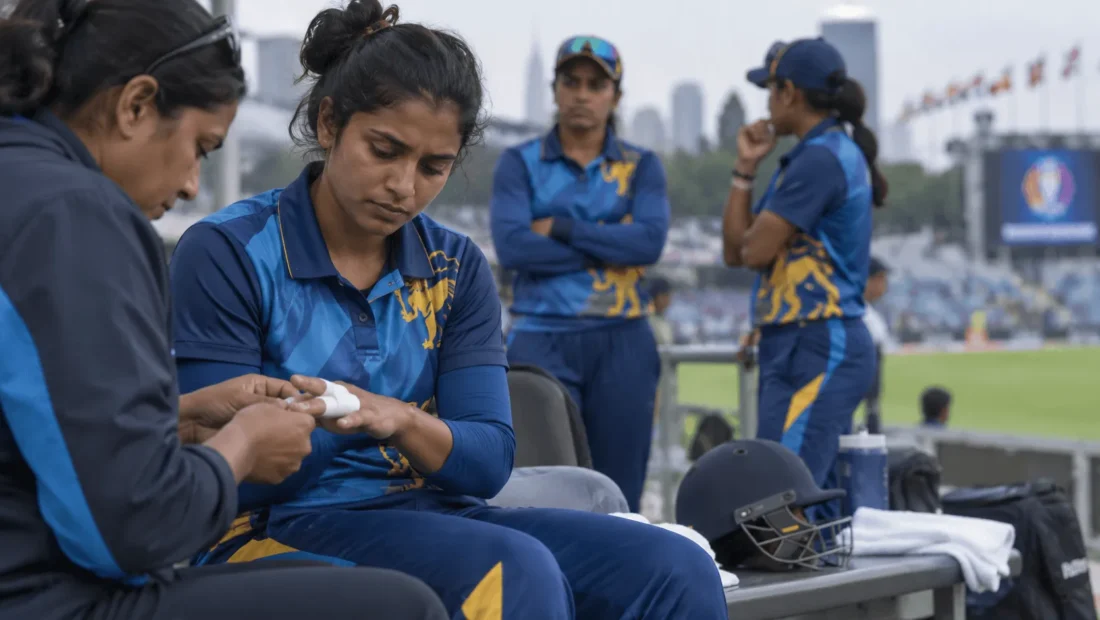
Sri Lanka will head to the 2026 Asian Games without Nilakshika Silva after the wicketkeeper-batter fractured a finger during the Asia Cup. Vishmi Gunaratne and Dewmi Vihanga are also absent, while Anushka Sanjeewani, Hansima Karunaratne and Rashmika Sewwandi have been brought into a squad that otherwise retains most of the senior core led by captain Chamari Athapaththu.
Silva misses the Asian Games after finger fracture
Nilakshika Silva will miss the 2026 Asian Games after fracturing a finger during the Asia Cup. Her absence is notable because she has been in good form this year and would otherwise have been expected to remain an important part of Sri Lanka’s batting group. The injury has forced the selectors to reshape the squad shortly before the team travels to Japan, with Anushka Sanjeewani, Hansima Karunaratne and Rashmika Sewwandi all included in the 15-player group.
Silva is not the only player missing. Vishmi Gunaratne has also been left out after a dip in run-scoring output. The 21-year-old has been part of Sri Lanka’s senior set-up since her teens, so her omission stands out even though it comes for a different reason. Where Silva is absent because of injury, Gunaratne’s exclusion reflects the selectors’ response to form. Those two changes alter the batting options near the top and middle of the order, but the core of the side remains familiar.
Sri Lanka have also moved on without spin-bowling allrounder Dewmi Vihanga, who was originally part of the recent Asia Cup squad but withdrew because of a knee injury. Nimasha Meepage replaced her then and retains her place for the Asian Games. Taken together, the changes show a squad dealing with both fitness problems and selection calls rather than a complete rebuild.
Three players return to strengthen the group
Anushka Sanjeewani, Hansima Karunaratne and Rashmika Sewwandi have all been recalled. Each has represented Sri Lanka since June, so none of the returns requires the team to integrate a completely unfamiliar player. Sanjeewani adds wicketkeeping and batting depth, Karunaratne strengthens the top-order options, and Sewwandi gives the squad another seam choice. Their inclusion helps cover the specific gaps created by injury and omission without changing the overall identity of the team.
The return of Sanjeewani is particularly useful because tournaments with short turnarounds can place extra demands on wicketkeepers. Kaushini Nuthyangana is also in the squad, so Sri Lanka have more than one keeping option. That creates tactical flexibility around batting order and workload. Karunaratne, meanwhile, offers another specialist batting choice at a time when Silva is injured and Gunaratne has been left out. Sewwandi broadens the pace resources around a side that still expects spin and all-round skills to play a major role.
This is why the squad can still be described as close to full strength despite the absences. The main leadership group remains intact, most of the established middle-order and all-round options are available, and the recalled players have recent international experience. The changes matter, but they do not force Sri Lanka to abandon the structure that carried them through recent competitions.
Athapaththu remains at the centre of the side
Chamari Athapaththu continues as captain and remains the most recognisable figure in the squad. Around her are Harshitha Samarawickrama, Kavisha Dilhari and Sugandika Kumari, all established members of the senior set-up. Their presence gives Sri Lanka continuity at a time when two batters and an allrounder are unavailable. In a short tournament, that continuity can be especially useful because teams have less time to recover from a poor match or experiment with unfamiliar combinations.
The 15-player group also includes Imesha Dulani, Sanjana Kavindi, Hasini Perera, Kaushini Nuthyangana, Nimasha Meepage, Chamudi Praboda, Mithali Ayodhya and Kawya Kavindi. The squad therefore mixes experienced internationals with players who have more recently moved into the senior group. The selection is not built around one dramatic overhaul. Instead, it looks like an attempt to preserve the strongest available core while replacing players who are unavailable or out of form.
Athapaththu’s role becomes even more important in that context. The captain is not only a senior batter but also a reference point for a group entering what is effectively a knockout event. Sri Lanka’s first match is against Malaysia on Friday, and the format gives every selection decision immediate weight. There is much less room for a slow start than in a long league competition.
An Asian Games field with little margin for error
Sri Lanka are one of eight teams in the women’s cricket event, alongside India, Bangladesh, Pakistan, Thailand, China, Malaysia and hosts Japan. The competition is described in the source as essentially a knockout tournament, which makes the opening fixture against Malaysia more important than a routine group-stage match might appear. A strong favourite can still be put under pressure quickly when there are few games available to correct mistakes.
That tournament structure also explains why squad depth matters even when the first-choice XI looks settled. Injuries, workload and match-ups can force changes with little warning. The presence of two wicketkeeping options, multiple allrounders and different bowling styles gives Sri Lanka some protection against that. The selectors have not simply replaced Silva with one batter and stopped there; they have built a 15-player group that can shift roles if needed.
At the same time, the absence of a batter in strong form is still a real loss. Silva’s injury removes a player who had been contributing well in 2026, while Gunaratne’s omission reduces the number of familiar top-order combinations available. Sri Lanka will therefore need the returning players and established senior batters to absorb more responsibility from the start.
The 15-player Sri Lanka squad
Sri Lanka’s Asian Games squad is led by Chamari Athapaththu. Imesha Dulani and Sanjana Kavindi are included among the batting options, with Hansima Karunaratne returning to the group. Harshitha Samarawickrama and Kavisha Dilhari remain key middle-order and all-round figures. Anushka Sanjeewani and Kaushini Nuthyangana provide wicketkeeping options, while Hasini Perera and Nimasha Meepage add further depth.
The bowling and all-round resources include Sugandika Dasanayaka, Rashmika Sewwandi, Chamudi Praboda, Mithali Ayodhya and Kawya Kavindi. The exact balance of the XI will depend on conditions and opposition, but the squad gives the team enough choices to vary its attack. Sewwandi’s recall is particularly relevant to the pace group, while the retained spin and all-round options preserve a familiar part of Sri Lanka’s recent strategy.
Sri Lanka squad for the 2026 Asian Games: Chamari Athapaththu (captain), Imesha Dulani, Sanjana Kavindi, Hansima Karunaratne, Harshitha Samarawickrama, Anushka Sanjeewani, Kavisha Dilhari, Hasini Perera, Kaushini Nuthyangana, Nimasha Meepage, Sugandika Dasanayaka, Rashmika Sewwandi, Chamudi Praboda, Mithali Ayodhya and Kawya Kavindi.
What changes without Nilakshika Silva
The immediate challenge is replacing Silva’s runs rather than simply filling her name on the team sheet. A finger fracture removes her from the event altogether, so Sri Lanka need a combination that works for the duration of the tournament rather than a short-term stopgap. Karunaratne’s recall gives the selectors one direct batting option, while Sanjeewani can influence the shape of the XI through both batting and wicketkeeping. The team could therefore replace Silva’s output by adjusting several roles rather than asking one player to duplicate her exactly.
Gunaratne’s omission complicates that process slightly because another familiar batter is missing at the same time. However, the squad still contains Athapaththu, Samarawickrama and Dilhari, and the returning players have all appeared for Sri Lanka since June. That recent exposure reduces the risk that the Asian Games becomes an abrupt step up for the replacements.
The selection story is therefore a mix of setback and continuity. Silva’s injury is unfortunate and Vihanga remains unavailable, while Gunaratne has been left out on form. Yet the captain and much of the senior core remain in place, and the three recalled players are not strangers to the international side. Sri Lanka enter the Asian Games with changes to manage, but not with a team starting from scratch.
The useful way to read this development is to separate the headline from the details underneath it. The source material gives a clear set of dates, names, figures and selection or regulatory facts, and those details matter more than broad assumptions. Looking at them together shows how the story developed step by step rather than as a single isolated announcement.
Another point is that the immediate announcement does not answer every question that could follow from it. Some decisions remain conditional, some outcomes depend on later events, and some comparisons involve products, players or tournaments with different structures. Keeping those limits in view makes the story more precise and avoids turning a factual update into a prediction.
For readers following the story over the coming days, the next useful checkpoints are the dates and milestones already contained in the announcement. Those are the points at which more evidence will become available, whether through a match, a filing, a tournament round or an updated schedule. Until then, the current facts provide the strongest basis for understanding what has changed and what has not.
The useful way to read this development is to separate the headline from the details underneath it. The source material gives a clear set of dates, names, figures and selection or regulatory facts, and those details matter more than broad assumptions. Looking at them together shows how the story developed step by step rather than as a single isolated announcement.