
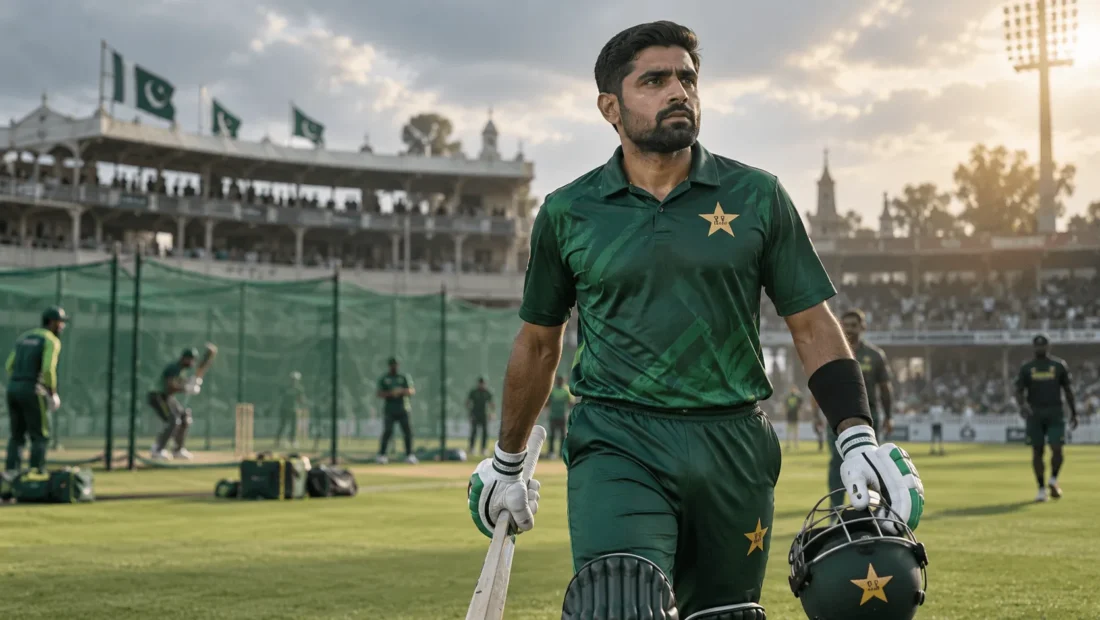
Babar Azam is returning to Pakistan’s domestic first-class competition for the first time in seven years, joining Oil & Gas Development Company Limited as a guest player in the ongoing President’s Trophy Grade 1. The move comes after Babar asked the PCB to place him with a side so he could remain connected to the longer format, and the board arranged for him to link up with OGDCL.
The decision is significant because Babar has spent most of his recent career moving between international commitments rather than domestic red-ball cricket. It also arrives at a difficult point in his Test career, with his form under sustained scrutiny and Pakistan struggling badly as a team. A return to domestic first-class cricket gives him something international schedules do not always provide: extended time in the format without the same immediate pressure attached to a Test series.
A long wait for another Test hundred
Babar’s last Test century came in December 2022, when he made 161 in a draw against New Zealand in Karachi. Since the beginning of 2023, his Test average has dropped to 30.43, which is 12.55 runs below his career average in the format. Across 39 innings in that period he has produced eight half-centuries, including a stretch of 18 innings in which he did not pass 41.
There have been signs of recovery. Four of those eight fifties have come in his last five Tests, and his highest score since the 2022 century is 88, made in Pakistan’s win in the second Test of their West Indies tour last month. That victory was Pakistan’s first away Test win since July 2023 and ended a sequence of eight consecutive away Test defeats.
Even so, the gap between fifties and a defining long innings remains part of the discussion around him. For a player who has carried the expectations of Pakistan’s batting for much of his career, a sequence of starts without a century attracts more attention than it might for another batter. Domestic first-class cricket offers a chance to spend longer periods at the crease and work through the technical questions that have followed him in recent series.
England tour adds pressure to the debate
The three-Test tour of England intensified the conversation. Pakistan were swept 3-0, and England’s fast bowlers repeatedly tested Babar with the short ball at Lord’s and Edgbaston. He missed the first Test at Headingley because of injury, so his tour was already disrupted before the broader technical debate developed.
Former Pakistan players have frequently analysed his technique in public, and the team’s poor results have made individual performances part of a much larger argument about standards in Test cricket. Babar’s return to domestic first-class competition can therefore be read as a practical response rather than a public statement. Instead of trying to solve the problem only through international matches or training camps, he has asked for actual red-ball game time.
That distinction matters. Practice can target a specific movement or weakness, but a first-class innings forces a batter to make decisions over several hours against changing fields, spells and match situations. The source does not say which technical adjustments Babar intends to make, so it would be wrong to invent them. What is clear is that he wants to stay in touch with the longer format through competition.
Why the domestic return stands out
Babar was not originally named in any of the eight teams when the PCB announced the squads for this season’s President’s Trophy and President’s Cup. His addition to OGDCL therefore comes after the tournament structure had already been set. The last time he played in a domestic first-class tournament was in 2019, when he captained Central Punjab to victory over Northern in the Quaid-e-Azam Trophy final.
Even that 2019 season contained only two domestic first-class matches for him because Pakistan toured Australia and then hosted Sri Lanka. It was the first Test series staged in Pakistan after the events of 2009. The source notes that 2019 was also the only season after 2015 in which Babar played more than one domestic first-class match in a season.
That history explains why the new appearance carries more weight than a routine club assignment. Babar has simply not spent much time in Pakistan’s domestic red-ball competition during the peak years of his international career. Returning now, while his Test form is under examination, gives the President’s Trophy unusual visibility.
Pakistan’s central contracts push internationals toward first-class cricket
Babar is not the only established international returning to the domestic competition. Shaheen Shah Afridi and Salman Agha are among the prominent Pakistan players involved this season. Their presence fits a wider call for regular internationals to play more domestic first-class cricket after a poor run of Test and ICC tournament results.
The PCB’s central contracts also contain explicit first-class requirements. Players in category A, described as Test specialists, must play at least six first-class matches in a year. Those in category AB, covering Test and ODI specialists, are required to play at least four. Players in BC, the white-ball specialist category, must play at least two. Those rules make domestic participation more than a matter of personal preference.
For the national system, the logic is easy to see. If leading players spend time in domestic first-class cricket, the competition gains quality while the players remain connected to the conditions and match rhythms from which Test cricketers are selected. The source does not say how many matches Babar will play for OGDCL, but his decision fits that broader policy direction.
A difficult wider picture for Pakistan
The context around Pakistan’s Test team is bleak. At the time of the report, Pakistan were ninth in the ICC Test rankings and bottom of the nine-team World Test Championship table, the same position in which they finished the previous cycle. The problems have not been confined to Test cricket either. Pakistan failed to reach the knockout stage of the previous four ICC tournaments and exited the home Champions Trophy in 2025 within five days after losing their first two group games to New Zealand and India.
Those results are why Babar’s form is discussed as part of a national problem rather than only an individual slump. A senior batter returning to domestic cricket does not fix a team’s structural issues by itself, but it is a visible example of an international player seeking more red-ball preparation instead of relying exclusively on the national schedule.
OGDCL gain a major reinforcement
For OGDCL, Babar’s arrival is valuable on its own terms. The department was relegated last season after finishing bottom of the eight-team President’s Trophy table, but returned when the PCB removed WAPDA and Sahir Associates for failing to comply with regulations. Kingsmen Academy also benefited from that decision after missing qualification through the Grade-II Gold competition.
OGDCL began the new campaign under pressure. In their opening match against PTV, they were 132 runs behind with three wickets down while following on at the close of the third day. They also had to play without regular captain Imam-ul-Haq, who was withdrawn from the squad after failing to appear for a fitness test, according to the information available to Cricinfo.
Dropping a player of Babar’s experience into that environment changes the profile of the side immediately. It gives OGDCL a top-order batter with extensive international experience and also brings attention to a team that had only just returned to the competition. For Babar, the situation should provide genuine first-class pressure rather than a low-intensity tune-up.
Aamer Jamal also returns through domestic cricket
The same round of domestic movement includes fast-bowling allrounder Aamer Jamal, who has joined first-class debutants Markhor IT Solutions as a guest player. Jamal is expected to be available for their second-round match against Khan Research Laboratories in Rawalpindi. He played for SNGPL in the previous President’s Trophy season and represented Lahore Whites in the 2025-26 Quaid-e-Azam Trophy.
Jamal was among the seven players sent home from England after Pakistan lost the series at Lord’s, although he had not played in either of the first two Tests. MITS were themselves under pressure in their opening match, following on against Hyderabad Kingsmen Academy after conceding 565 for 7 declared. Jamal will be the first Test cricketer on their roster.
A practical route back toward Test rhythm
For Babar, the important part of the move is not nostalgia for domestic cricket; it is repetition in the format he is trying to improve. His recent numbers show that he has begun reaching fifty more often again, but the long wait for a hundred and Pakistan’s wider Test decline keep the spotlight fixed on every innings.
The President’s Trophy cannot replicate the pressure of Test cricket, but it can give him time at the crease, red-ball decision-making and match situations that are difficult to recreate elsewhere. The fact that Babar initiated the request to be placed with a team suggests he sees value in that environment at this stage of his career.
Seven years after his last sustained involvement in Pakistan’s domestic first-class scene, his return therefore arrives with a clear purpose. OGDCL need runs and stability, Pakistan need senior players in better red-ball form, and Babar needs opportunities to turn recent half-centuries into longer innings. The President’s Trophy now gives all three interests a place to meet.