
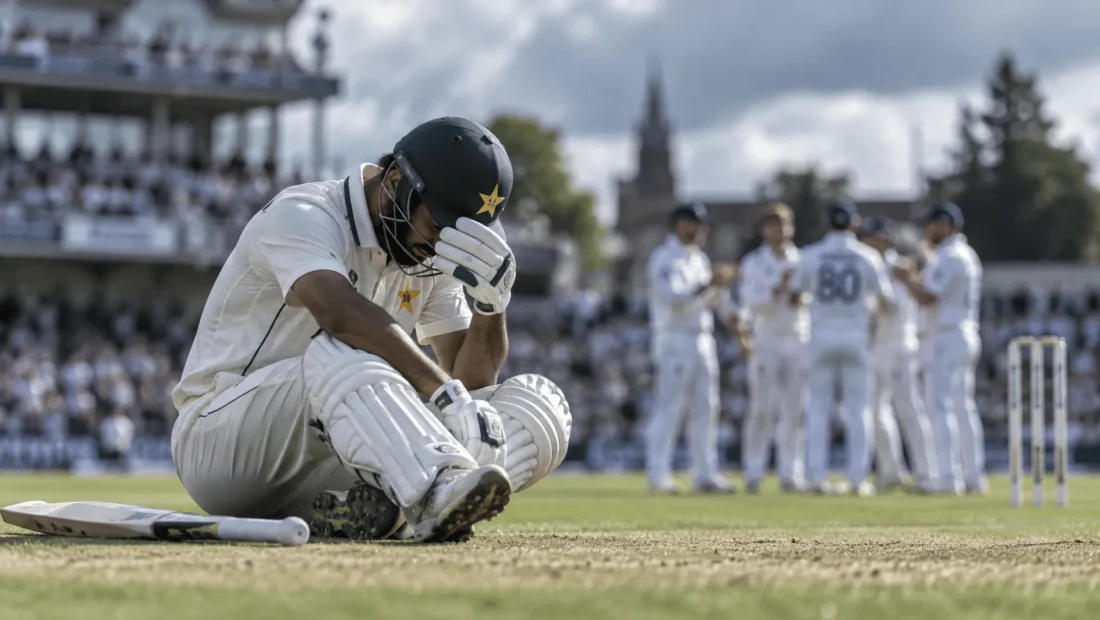
Pakistan’s difficult Test tour of England has ended with another setback, this time away from the scoreboard. After being swept 3-0 in the series, the team has been docked 11 World Test Championship points for a slow over-rate in the third and final Test at Edgbaston. The penalty leaves Pakistan with only five points in the current championship cycle and pushes an already poor campaign into an even more difficult position.
The International Cricket Council said Pakistan were 11 overs short of the required rate after time allowances had been taken into account. Under the applicable penalty, that translated into an 11-point deduction. The team was also fined 50% of its match fee. The scale of the points loss is especially damaging because Pakistan had very little margin left after a sequence of defeats, and the deduction now places them far below the side immediately above them in the table.
Eleven Overs Short Becomes an Eleven-Point Blow
Slow over-rate penalties can sometimes look secondary next to the result of a Test match, but in a championship system they can have a direct effect on the standings. Pakistan’s case is a particularly clear example. The side was judged to be 11 overs behind the target at Edgbaston once the permitted allowances were considered. Each missing over effectively translated into a lost championship point, producing a total deduction of 11.
The financial sanction was also significant, with 50% of the team’s match fee taken as part of the penalty. Even so, the championship points are the more important consequence for the broader campaign. Pakistan had already been beaten throughout the England series, so the deduction was applied to a total that was already low. Instead of leaving the tour with only the damage caused by the 3-0 defeat, they now carry an additional standings penalty into their remaining series.
The source puts Pakistan on five points after the deduction, equivalent to a points percentage of 4.63. West Indies, in eighth place, are listed with 30 points and a percentage of 20.83. That gap shows just how isolated Pakistan have become at the bottom of the table. They had already slipped from eighth to ninth after losing the opening Test of the England tour at Headingley, and the rest of the series only deepened the problem.
The England Tour Has Been Costly in Every Sense
The over-rate penalty arrived after Pakistan had been swept 3-0, a result that already represented a major sporting setback. The final Test at Edgbaston did not create the team’s championship problems on its own. It added to a sequence in which poor results, squad disruption and now a points deduction have all accumulated in a short period.
The second Test at Lord’s was particularly consequential. Pakistan lost that match by 194 runs, and the defeat was followed by a sweeping overhaul of the squad. Seven players were sent home, including Mohammad Rizwan, Salman Agha and Imam-ul-Haq. Head coach Sarfaraz Ahmed and bowling coach Umar Gul were also removed from the touring group. Those changes meant the team entered the final part of the tour dealing with instability as well as the pressure of results.
That context makes the Edgbaston sanction more than an isolated administrative issue. A team already reacting to major changes then lost 11 WTC points because of the pace at which it completed its overs. The penalty therefore becomes part of the same broader story: Pakistan’s England tour produced damage in the series score, in the championship table and inside the playing group.
Pakistan’s WTC Position Is Now Extremely Weak
With five points and a 4.63 points percentage, Pakistan sit well below West Indies in eighth. The source makes clear that this is not a situation created solely by the deduction. Pakistan have won only two of their nine Tests in the cycle so far. The penalty simply makes an already poor record harder to recover from.
World Test Championship standings reward teams across an extended schedule, so one result does not usually define a campaign. The problem for Pakistan is that the negative results have become cumulative. Losing matches reduces the points available, and an over-rate deduction then removes points that had already been earned or retained. The combination leaves little room for further mistakes in the remaining series.
The gap to West Indies provides useful perspective. Pakistan’s five points are not just slightly behind eighth place. West Indies are listed with 30. The percentage figures tell the same story, 4.63 compared with 20.83. Even without projecting future scenarios that are not contained in the source, it is clear that Pakistan need a major change in form if they are to make the lower end of the table more competitive.
Two Series Remain in the Cycle
Pakistan still have two series scheduled in the WTC 2025-cycle referenced by the source. They are due to face Sri Lanka in November and New Zealand in March 2027. Those fixtures now carry even more importance because there are so few opportunities left to improve the team’s record.
West Indies, meanwhile, have a series against Bangladesh in October. That matters because Pakistan are not trying to recover points in isolation. The teams above them also have matches in which they can improve their own totals. Pakistan therefore need positive results while also dealing with the reality that the gap can move in both directions.
The remaining schedule at least gives the side a chance to respond on the field. The source does not provide qualification calculations or suggest a realistic path to a particular finishing position, so it would be misleading to make one up. What can be said is that Pakistan have very little margin left. Every Test in the remaining two series will be played against the background of a campaign in which wins have been rare and points have now been lost through an over-rate sanction as well.
The Penalty Adds Pressure to a Team in Transition
The timing is also uncomfortable because Pakistan are already in a period of major personnel change. The decision to send seven players home after Lord’s, together with the removal of the head coach and bowling coach from the touring group, indicates that the response to the England defeats went well beyond normal selection adjustments.
Rizwan, Salman Agha and Imam-ul-Haq were among those sent home. That means recognisable members of the side were removed while the tour was still taking place. When a team is making changes on that scale, the final Test becomes a test not only of technique but also of organisation and discipline. The slow over-rate judgment at Edgbaston suggests that one of those basic match-management requirements was not met.
There is no need to overstate the connection. The source does not say the squad overhaul caused the over-rate problem, and the ICC penalty concerns only the number of overs completed within the required time. Still, the two developments sit within the same difficult period and contribute to a sense that Pakistan have had problems on several fronts at once.
Why Over-Rate Discipline Matters More in a Championship
An over-rate can feel like a procedural issue when viewed within a single day of Test cricket. Teams manage field changes, bowling rotations, reviews and tactical discussions, and time can disappear gradually. In a championship structure, however, the consequence is no longer merely a warning or a fine. Points deductions turn time management into a competitive factor.
Pakistan have now learned that in the most direct way possible. Eleven overs short meant eleven points removed. The team’s 50% match-fee fine adds a financial punishment, but it is the table that will preserve the impact for the rest of the cycle. Those lost points cannot be recovered by replaying Edgbaston. The only response available is to perform better in the matches that remain and avoid further deductions.
For the coaching and leadership group that emerges from the current transition, over-rate control will therefore need to sit alongside the obvious priorities of batting, bowling and selection. A side at the bottom of the WTC standings cannot afford to lose points for reasons unrelated to the final result. When wins are scarce, every point becomes more valuable.
A Difficult Cycle Reaches a New Low
The broader numbers underline the seriousness of the situation. Pakistan have won two of nine Tests in the cycle. They were swept in England. They are down to five championship points after the Edgbaston deduction. They have also changed a large part of the touring group following the Lord’s defeat. Each fact would be a concern on its own; together they explain why the latest penalty feels especially damaging.
The next opportunity to change the tone comes against Sri Lanka in November, followed by New Zealand in March 2027. Those series cannot erase the England tour, but they can determine whether Pakistan finish the cycle with signs of recovery or remain entrenched at the bottom. Before then, the team will also have to settle the personnel and coaching questions created by the overhaul.
The Edgbaston over-rate penalty is therefore both a specific sanction and a symbol of a wider problem. Pakistan were already struggling for results, and now administrative discipline has cost them additional championship points. With only two series left, the room for error has become extremely small. The challenge is no longer simply to win more Tests. It is to rebuild enough stability that the team stops losing ground in areas it can control.